• KGS/USD = 0.01144 0%
  • KZT/USD = 0.00213 0%
  • TJS/USD = 0.10456 0.19%
  • UZS/USD = 0.00008 0%
  • TMT/USD = 0.28490 0%
  • KGS/USD = 0.01144 0%
  • KZT/USD = 0.00213 0%
  • TJS/USD = 0.10456 0.19%
  • UZS/USD = 0.00008 0%
  • TMT/USD = 0.28490 0%
  • KGS/USD = 0.01144 0%
  • KZT/USD = 0.00213 0%
  • TJS/USD = 0.10456 0.19%
  • UZS/USD = 0.00008 0%
  • TMT/USD = 0.28490 0%
  • KGS/USD = 0.01144 0%
  • KZT/USD = 0.00213 0%
  • TJS/USD = 0.10456 0.19%
  • UZS/USD = 0.00008 0%
  • TMT/USD = 0.28490 0%
  • KGS/USD = 0.01144 0%
  • KZT/USD = 0.00213 0%
  • TJS/USD = 0.10456 0.19%
  • UZS/USD = 0.00008 0%
  • TMT/USD = 0.28490 0%
  • KGS/USD = 0.01144 0%
  • KZT/USD = 0.00213 0%
  • TJS/USD = 0.10456 0.19%
  • UZS/USD = 0.00008 0%
  • TMT/USD = 0.28490 0%
  • KGS/USD = 0.01144 0%
  • KZT/USD = 0.00213 0%
  • TJS/USD = 0.10456 0.19%
  • UZS/USD = 0.00008 0%
  • TMT/USD = 0.28490 0%
  • KGS/USD = 0.01144 0%
  • KZT/USD = 0.00213 0%
  • TJS/USD = 0.10456 0.19%
  • UZS/USD = 0.00008 0%
  • TMT/USD = 0.28490 0%

Central Asia Updates from Mideast Conflict

Kazakhstan has expressed sorrow over the deaths of young students in what appeared to be an air strike that hit a girls’ primary school in the southern Iranian city of Minab.

“I received the news of the death of 160 schoolgirls in Iran – with deep distress. The interruption of the lives of children, who must get education and step into the future on a peaceful day, is an irreplaceable tragedy for all humanity,” Education Minister Zhuldyz Suleimenova said on Facebook on Monday.

“As a parent, I believe that children should never be victims of any kind of conflict, or political disputes,” Suleimenova said. “Their safety and well-being is one of the most important values for the international community and for every state.”

Health officials and state media in Iran have reported a higher death toll of at least 175 in the destruction at the school on Saturday, saying most of the dead were probably children.

The U.S. military said it was looking into reports of civilian casualties during its operations against the Iranian government.

Some reports say the school that was hit is near an Iranian military installation, one of many targeted by U.S. and Israeli strikes since the military air campaign began on Saturday.

Kyrgyzstan is working to help hundreds of its citizens who are stranded in Gulf countries because of the Mideast conflict.

Diplomats are negotiating with hotels to make sure that Kyrgyz nationals are not evicted, Seitek Zhumakadyr uulu, head of the consular department of Kyrgyzstan’s Ministry of Foreign Affairs, said on Monday.

He said there are 800 stranded Kyrgyz citizens in Qatar and about 1,000 in the United Arab Emirates, according to Kyrgyzstan’s state news agency Kabar.

Most Kyrgyz citizens in Saudi Arabia are performing Umrah, the Islamic pilgrimage to Mecca, the official said. Thousands of pilgrims have been affected by the air strikes on Iran and retaliation by Iranian forces. Airspace in many parts of the region is closed to commercial traffic and airlines have suspended flights.

However, Ulukbek Maripov, Kyrgyzstan’s ambassador in Saudi Arabia, has said that airports there are operating relatively well.

There are no reports of Kyrgyz civilian casualties in the conflict.

Uzbekistan’s diplomats in Turkmenistan’s capital Ashgabat are arranging assistance for Uzbek citizens who want to leave Iran and cross into neighboring Turkmenistan.

“Embassy officials will meet citizens at the Turkmen-Iranian border crossing in the city of Sarakhs,” Uzbekistan’s state news agency Dunyo reported. “Official vehicles of the Embassy of Uzbekistan in Ashgabat have been mobilized to facilitate onward travel arrangements.”

The Iranian city of Sarakhs is a key transit point for trade between Iran and Central Asia. The border between Iran and Turkmenistan is more than 1,000 kilometers.

A Tajik citizen who was leaving Iran by crossing into Azerbaijan needed medical assistance at the border.

“A female citizen of Tajikistan experienced health problems during the evacuation from Iran via the Azerbaijani border,” the Azerbaijani Press Agency reported. “She applied to a doctor present at the checkpoint. The Tajik citizen was provided with the necessary first medical aid by the doctors.”

A number of Tajik citizens are among people from a range of countries seeking to leave Iran since U.S. and Israeli air strikes began three days ago. Azerbaijan is in contact with various foreign governments trying to ensure the safe passage of their nationals.

Kazakhstan Adopts Pragmatic AI Regulation in Financial Sector

As of early 2026, the global financial market faces a strategic choice: impose tighter restrictions on artificial intelligence or allow the technology to evolve within existing regulatory frameworks. While the European Union has opted for comprehensive regulation, Kazakhstan has adopted a more pragmatic approach.

According to the National Bank of Kazakhstan, approximately 75% of the country’s banks already use AI technologies— a share that has risen steadily over the past year — and 88% plan to expand their use. This indicates that AI integration is no longer experimental but systemic within the financial sector. Banks are increasingly deploying AI in credit underwriting, fraud detection, and anti-money-laundering transaction screening

Madina Abylkasymova, Chair of the Agency for Regulation and Development of the Financial Market, articulated the principle of technological neutrality as early as 2025: the regulator does not intend to introduce artificial constraints until uniform global standards for AI are established. In her view, existing regulatory frameworks remain sufficient. Cybersecurity requirements, data protection standards, and risk management rules continue to apply regardless of whether decisions are made by humans or algorithms. Accountability and oversight remain unchanged.

Infrastructure Before Regulation

At the same time, the market faces significant structural barriers. These include a shortage of specialists at the intersection of finance and data science, the absence of unified data standards, and the high cost of computing infrastructure. The introduction of additional “European-style” restrictions could disproportionately burden smaller market participants and potentially force them out of the sector. Over the past twelve months, discussions have shifted from pilot experimentation to operational scaling across core banking functions. Some market participants have privately expressed concern that regulatory lag could eventually create supervisory blind spots as AI models grow more complex.

Recognizing the high cost of entering the AI ecosystem, the state is assuming an infrastructural role. Timur Suleimenov, Governor of the National Bank of Kazakhstan, operating within the broader digital modernization agenda supported by President Kassym-Jomart Tokayev has outlined a strategic objective: to establish secure and scalable infrastructure to support AI development in the financial sector.

This includes the launch of domestic data centers and the expansion of partnerships with global technology companies. The stated goal is to strengthen technological sovereignty and ensure the protection of citizens’ personal data. In practical terms, the regulator aims to create a sovereign “sandbox” in which fintech companies can test algorithms without transferring sensitive information to foreign servers.

Supervisory Modernization

The rapid expansion of AI also requires a transformation of supervisory practices. Currently, 39% of financial organizations in Kazakhstan use neural networks in some capacity. Over the past year, the number of companies that have progressed from pilot projects to partial implementation has nearly doubled.

International institutions, including the Bank for International Settlements and the International Monetary Fund, argue that AI does not generate fundamentally new categories of risk. Rather, it accelerates and amplifies existing risks, credit, market, and operational. This suggests that regulators do not need to rewrite foundational rules but must enhance the speed, scale, and depth of analytical capabilities.

In response, the National Bank of Kazakhstan and the Agency for Regulation and Development of the Financial Market have launched an internal SupTech (Supervisory Technology) program, a modernization effort supported at both the regulatory level by Timur Suleimenov and at the executive level by President Kassym-Jomart Tokayev. The first phase involves deploying AI assistants for document analysis and chatbots to support knowledge management. In subsequent stages, authorities plan to introduce multi-agent autonomous systems capable of analyzing large transaction datasets in real time, detecting systemic risk signals, identifying potential market overheating, and flagging suspicious patterns that may indicate money laundering.

Kazakhstan’s approach reflects a deliberate balancing act: encouraging technological innovation while preserving regulatory stability. Rather than imposing preemptive restrictions, the country is investing in infrastructure and supervisory modernization, seeking to shape a controlled yet dynamic AI ecosystem within its financial market. The next phase will test whether infrastructure investment and supervisory modernization can keep pace with accelerating model deployment across the sector.

Uzbekistan Urges Restraint as Afghanistan-Pakistan Border Clashes Escalate

Armed clashes along the Afghanistan-Pakistan border have intensified, prompting Uzbekistan to call for restraint and a diplomatic resolution.

Active hostilities reportedly began after Afghan forces opened fire on Pakistani military posts in mountainous areas along the Durand Line in northwestern Pakistan, according to media reports on February 27.

Officials in Uzbekistan view stability along the Afghanistan-Pakistan border as directly linked to Central Asian security. Potential regional risks include the proliferation of illegal weapons, drug trafficking, militant activity, refugee flows, and possible disruptions to trade and transit corridors. Uzbekistan has expanded economic and infrastructure cooperation with Afghanistan in recent years, making border stability a strategic priority for both the country and the wider region.

Exchanges of fire lasted more than two hours. Clashes were reported in the Afghan provinces of Khost, Paktia, and Nuristan, as well as near the Torkham border crossing, one of the region’s key transit routes.

According to reports from Afghan sources, Afghan forces captured 19 Pakistani checkpoints during a large-scale operation and claimed that approximately 55 Pakistani soldiers were killed. Afghan authorities described the operation as a response to recent Pakistani airstrikes on Afghan territory. Kabul reported its own casualties at eight soldiers killed and 11 wounded.

Within hours, Pakistan launched a counteroffensive across multiple sections of the border under an operation referred to as “Fury of Truth.” The escalation followed earlier Pakistani airstrikes in Nangarhar and Paktika provinces, which Islamabad said targeted fighters linked to Tehreek-e-Taliban Pakistan (TTP) and Islamic State-Khorasan. Pakistani officials stated that at least 70 militants were killed, while Taliban authorities asserted that civilian areas had been struck.

The United Nations reported at least 13 civilian deaths and seven injuries in Nangarhar and confirmed no civilian casualties in Paktika.

As tensions rose, Pakistan’s Special Representative for Afghanistan, Mohammad Sadiq, said he discussed regional security concerns with Uzbekistan’s Special Representative for Afghanistan, Ismatilla Irgashev. In a statement posted on X, Sadiq referred to reports alleging that more than 2,500 Uzbek militants are currently based in Afghanistan, describing them as one of the largest foreign militant groups operating in the country after TTP.

United Nations Security Council reports have previously confirmed the presence of several armed groups in Afghanistan, including the Islamic Movement of Uzbekistan. However, independent verification of the current figures cited by Pakistani officials has not been publicly confirmed.

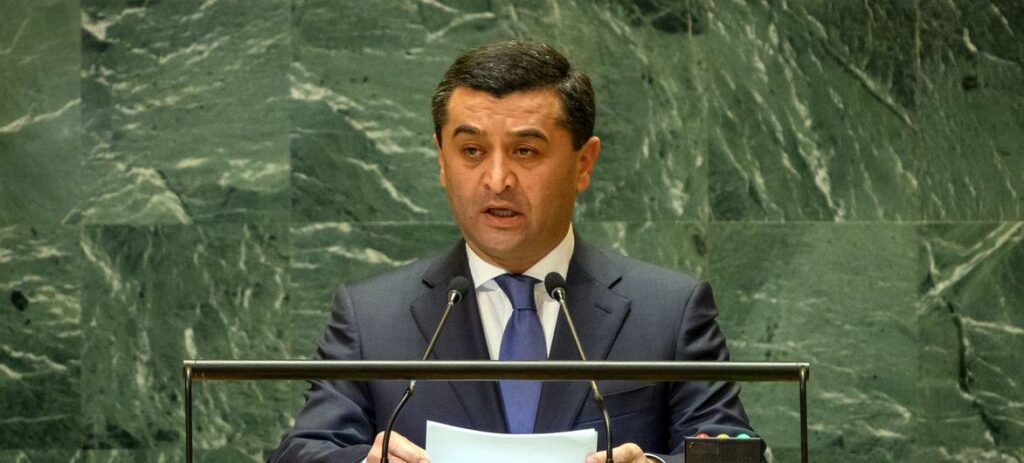
Uzbekistan responded through diplomatic channels. Foreign Minister Bakhtiyor Saidov held separate phone conversations with Afghanistan’s Foreign Minister Mawlawi Amir Khan Muttaqi and Pakistan’s Deputy Prime Minister and Foreign Minister Muhammad Ishaq Dar. The discussions focused on preventing further escalation and preserving stability along the border.

Saidov emphasized the importance of restraint and dialogue, stating that diplomatic engagement must remain the primary mechanism for addressing emerging challenges. Uzbekistan’s Ministry of Foreign Affairs later issued a formal statement expressing deep concern over the deterioration of the situation and calling for an immediate ceasefire, maximum restraint, and the resolution of disagreements through peaceful political and diplomatic means based on respect for sovereignty and territorial integrity.

Largest Aircraft Maintenance Center in Central Asia Under Construction in Kazakhstan

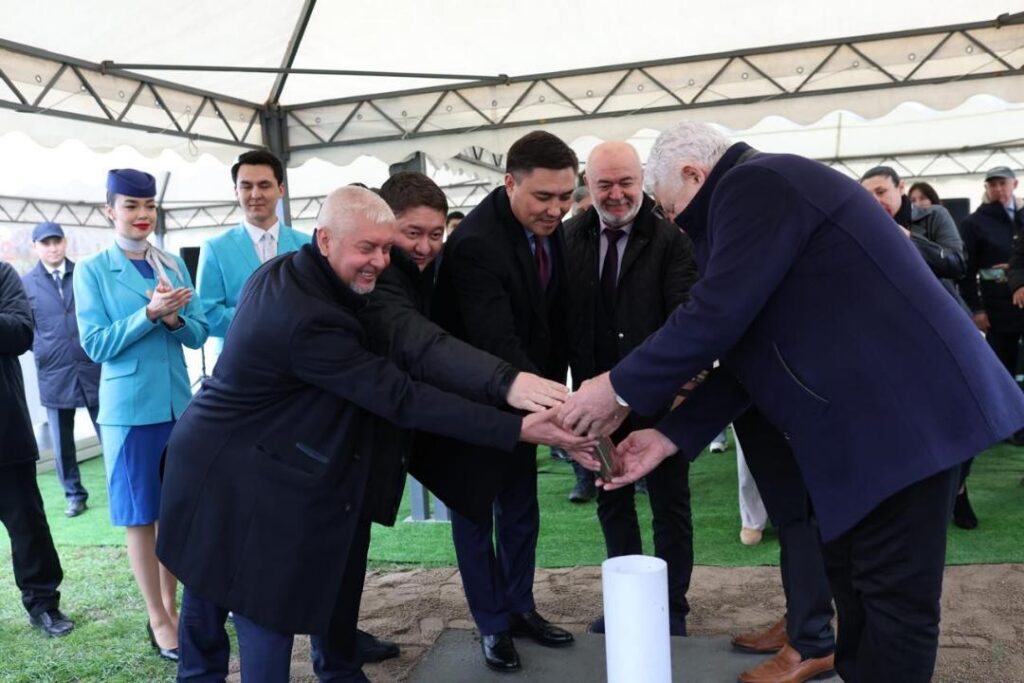
Kazakhstan’s SCAT Airlines, in partnership with Boeing, has begun construction of a new maintenance, repair, and overhaul (MRO) center in Shymkent. The facility is expected to become the largest aircraft maintenance complex in Kazakhstan and across Central Asia.

The capsule-laying ceremony, held on February 27, was attended by Shymkent Mayor Gabit Syzdykbekov, Deputy Transport Minister Talgat Lastayev, and Boeing Vice President of Sales and Marketing for Eurasia, India, and South Asia Paul Righi.

According to the Ministry of Transport, the center will specialize in servicing Boeing aircraft, including the Boeing 737 (Classic, NG, and MAX), Boeing 757 and 767 models, as well as the Boeing 777 widebody aircraft.

The facility will occupy 10 hectares, with engineering and technical infrastructure covering 45,000 square meters. The aircraft parking area alone will span more than six hectares.

The project is intended to establish a modern, internationally certified repair and maintenance base capable of servicing not only domestic carriers but also foreign airlines, thereby expanding Kazakhstan’s technical expertise and aviation services export potential.

Kazakhstan’s civil aviation sector continues to demonstrate steady growth. According to the Ministry of Transport, in 2025 the country’s airports handled 31.8 million passengers, compared to 29.7 million in 2024. Cargo traffic reached 173,300 tons, up from 170,900 tons the previous year.

Deputy Minister Talgat Lastayev stated that the growth in traffic has been accompanied by systematic efforts to strengthen safety oversight. Kazakhstan’s compliance with international aviation safety standards reached 95.7%, significantly exceeding global and regional averages and placing the country among the world’s top 20 performers in this category.

Lastayev also noted that KazMunayGas-Aero LLP, a jet fuel supply subsidiary of the national oil and gas company KazMunayGas, has been granted direct access to airport infrastructure and has begun providing direct “into-plane” refueling services. This has reduced the average cost of jet fuel at Kazakh airports.

According to the ministry, direct refueling without intermediaries has lowered jet fuel prices to below $1,000 per ton, compared to $1,200-$1,300 per ton in other countries.

The new refueling mechanism was introduced on the instructions of the President of Kazakhstan to support the development of international air hubs by ensuring stable supplies of competitively priced aviation fuel. Officials say it is expected to improve the reliability of fuel supply for airlines and reinforce the country’s role as a key transit hub.

Iran Volatility Tests Central Asia’s Overland Corridors

The current escalation around Iran holds the potential for transforming the long-term geopolitical configuration of Eurasia, including Central Asia. In the short and medium term, aside from the security and safety of its citizens, Central Asia’s main concern is economic, because it puts stress on overland rail and trucking routes that cross Iranian territory. Central Asian exporters do not ship through the Gulf, so for now the key issue is whether an Iran-crossing land route remains reliable enough, and financeable enough, to serve as a routine outlet for trade.

The Iran transit option differs from trans-Caspian reliance on ports and rail interfaces around the Caspian Sea, transiting to onward rail across the South Caucasus and into Europe. The Iran option offers a continuous land arc from Central Asian railheads and road networks into Iran, then onward to Türkiye and connected European rail networks, with the additional possibility of reaching Iran’s southern ports for Indian Ocean-facing trade. Each route has its own chokepoints, paperwork burdens, and exposure to risk premiums.

Rail is efficient for bulk and container flows when schedules and documentation are stable. Trucking provides flexibility, short-notice capacity, and last-mile options, but it is more sensitive to security conditions and border clearance delays. Technical capacity at the Iran–Turkmenistan crossings is key. Recent reports of discussions in Sarakhs describe efforts to expand the use of a specialized rail logistics process whereby entire wheel assemblies are replaced on railcars to transition between different track gauges. There is also a need to address customs constraints at Sarakhs and Incheh Borun.

Against that operational background, Kazakhstan has signaled diplomatic attention to Gulf partners and Jordan. President Kassym-Jomart Tokayev has sent messages of support to leaders of the United Arab Emirates, Saudi Arabia, Qatar, Bahrain, and Kuwait, followed by a similar message to Jordan, and a phone call with Qatar’s emir. The language emphasized solidarity and diplomacy and, in commercial terms, reads as partner-management. It reassures major investors and energy-market counterparts that Kazakhstan is engaged, attentive, and positioning itself for stability rather than escalation.

The trans-Iran rail foundation is over a decade old. On December 3, 2014, the presidents of Kazakhstan, Turkmenistan, and Iran inaugurated the 928-kilometer Uzen–Bereket–Gorgan railway, characterized by RFE/RL (which gave the length as 935 kilometers) as the shortest railway connecting the three states. The International Union of Railways similarly notes the inauguration of the Gorgan–Inche Boroun link on that date as part of the corridor connecting Iran to Turkmenistan and Kazakhstan.

Recent reporting suggests renewed efforts to operationalize the Iran option as a westbound channel. Uzbekistan, in cooperation with Türkiye, launched freight rail services along the Uzbekistan–Turkmenistan–Iran–Türkiye route in 2022. The Organization of Turkic States described a December 2022 event in Tashkent as the first freight train organized from Türkiye to Uzbekistan, which anchors the same basic idea: make westbound rail via Iran more regular and more visible to logistics markets. The point is not that Iran becomes the sole answer, but that Central Asian exporters and transit states have been trying to keep multiple workable routes open at the same time.

The relevance of the Gulf is greatest regarding finance and logistics execution. The UAE’s AD Ports Group has completed its acquisition of a 60% stake in Tbilisi Dry Port, which has direct rail links to Türkiye and Black Sea ports. In Kazakhstan, AD Ports Group has announced agreements tied to fleet expansion and a planned multipurpose terminal at Kuryk, stating that these moves bring its overall investment in Kazakhstan to $775 million.

Against this backdrop, three scenarios frame the implications of the Iran crisis without locking in a single forecast.

The first scenario is a political transition in Iran with recoverable state capacity. The gain for Central Asia here would be that Iran could become a standard transit jurisdiction rather than a special-case route. A reduction in transaction costs would make rail and trucking more attractive, and insurance would become more regularized. Payment channels would become more fluid as sanctions are lifted. All this means logistics operators can commit to schedules without building elaborate escape clauses into contracts. The medium to long-term effect would be to expand corridor choices and reduce dependence on any single route.

The second scenario is governance degradation without a clean transition. Under this scenario, authority in Iran fragments, and enforcement becomes uneven. The result here would be that transit becomes episodic; delays and local disruptions become hard to predict. In this environment, trucking tends to carry a larger security and delay premium than rail and can substitute for it only occasionally and on short horizons. Shippers would respond by shifting time-sensitive or high-value cargo toward routes with better administrative predictability. Iran-crossing routes would be sporadic rather than foundational.

The third scenario is regime continuity under sustained sanctions pressure. This case makes trans-Iran connectivity usable but bounded. Some transit may continue, but compliance, financing, and payment risks would limit its scale. For Central Asia, the practical effect is a relatively low ceiling on how much Iran could function as a stabilizing outlet. Exporters would tend to favor other corridors that are more commercially viable and lower risk.

For Central Asia, the policy posture that holds across scenarios is to treat redundancy as a strategic necessity rather than a luxury and keep the trans-Iran option usable only where it remains operationally and commercially viable. Tokayev’s Gulf and Jordan outreach is consistent with that approach as a diplomatic move aimed at stabilizing the commercial environment around corridor investment and trade connectivity.

Central Asia Confronts Iran War Fallout as Trade Routes and Citizens Come Under Pressure

Central Asian governments are racing to protect citizens and keep trade moving as the U.S.–Israel war with Iran widens across the Middle East, disrupting airspace and driving up shipping and energy costs. The effects of the conflict are reaching a region that has spent the past four years trying to diversify trade routes and reduce dependence on maritime chokepoints, now disrupted by rising risk and transport volatility.

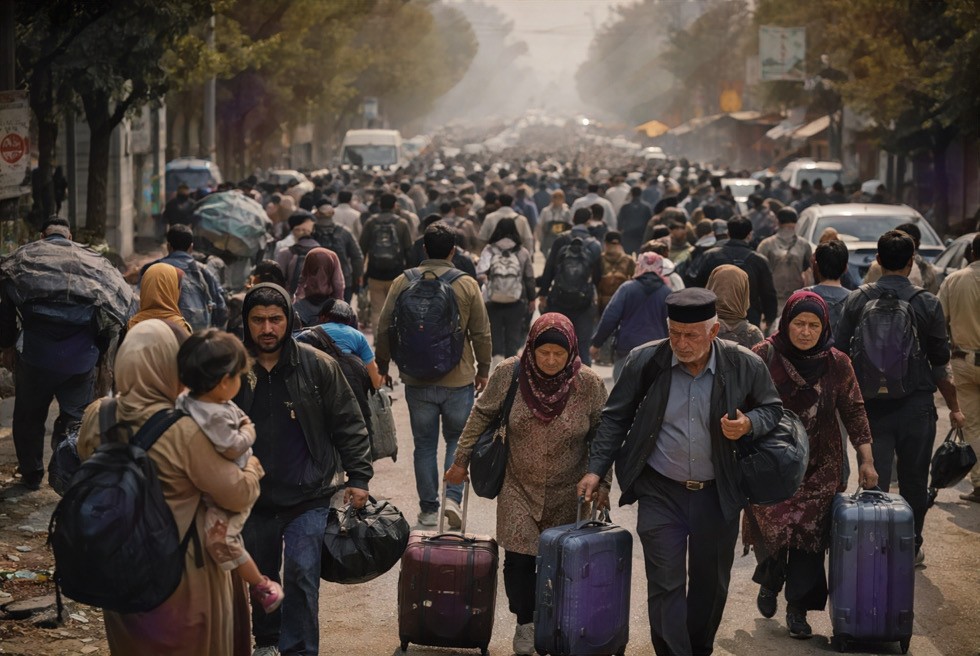
The threat to its citizens has become immediate for Central Asian governments. On March 1, Kazakhstan’s Foreign Ministry said that it was working on evacuation measures for its nationals in escalation zones and urged citizens to follow official updates from diplomatic missions. It also advised Kazakh citizens in Iran to explore overland exits, including via Azerbaijan, Armenia, Türkiye, and Turkmenistan, given airspace closures and flight suspensions. Uzbekistan’s Foreign Ministry issued safety guidance for citizens in the United Arab Emirates, urging them to avoid crowded areas and adhere to official security directives as tensions in the region escalated. Tajik nationals have already been among those leaving Iran through Azerbaijan’s Astara crossing, with The Times of Central Asia reporting yesterday that five civilians from Tajikistan are among foreigners from numerous countries who have crossed from Iran into Azerbaijan.

For Central Asia, the crisis is hitting both its people and its trade routes. The same border crossings used for evacuations sit on corridors that carry freight and connect the region to southern markets. Azerbaijan’s role as a transit hub has grown sharply over the past decade, but in this crisis, it is also a pressure valve for land exits from Iran. As of March 2, more than 300 people have been evacuated from Iran via Azerbaijan. Any tightening at borders or disruptions to rail and road links around the Caspian immediately affect how Central Asian states move both people and cargo.

Oil and shipping costs are rising sharply. On March 1, oil prices jumped by around 10%, with analysts warning prices could move toward $100 a barrel if disruption in the Strait of Hormuz worsens. The impact across Central Asia has been uneven. Kazakhstan may see stronger export revenues in the short term due to higher crude prices, but that gain comes with volatility and increased import costs across the region. ING stated that stronger commodity prices could improve the external balance of fuel exporters such as Kazakhstan, while increasing inflation risks for importers.

Shipping poses a deeper structural risk. Tanker owners and traders have slowed or suspended transits through the Strait of Hormuz because of security fears and insurance constraints, even without a formal blockade. Higher risk premiums feed directly into freight rates on the routes Central Asian exporters use to reach Europe, the Gulf, and South Asia. When insurers reprice war risk, smaller shippers and landlocked economies absorb the cost first.

Iran is central to Central Asia’s trade geography. It serves as a transit state for the southern corridor linking Central Asian rail and port networks to Türkiye, Europe, and the Gulf. Central Asian capitals see Iranian ports as a gateway to the Persian Gulf and Indian Ocean and a way to diversify export routes beyond northern corridors, even as they assess cost, risk, and political uncertainty in the region. Turkmenistan, which borders Iran and anchors much of this routing, has continued talks with Tehran on rail connectivity, including discussions in Sarakhs that Iranian media described as strategic for transit corridors.

The strain is also visible in aviation. Airspace closures and hub disruptions have forced airlines to reroute or cancel flights, cutting cargo capacity and raising costs for high-value goods that usually move by air. As shipments shift to land and sea, congestion has increased at rail terminals and ports used by Central Asian supply chains. Exporters of perishables, time-sensitive components, and precious metals are facing immediate exposure.

Central Asia has spent several years building alternative routes, including the Trans-Caspian corridor, also known as the Middle Corridor. An OECD report from November 2025 on Kazakhstan’s segment of the Corridor documented rising sea cargo volumes and the need to upgrade port infrastructure to sustain growth. Rising Gulf instability increases pressure on this route; greater freight diversion toward Eurasian land corridors would intensify congestion at Caspian ports, strain ferry capacity, and slow border processing.

Transport planning now intersects directly with geopolitics. On February 19, President Donald Trump convened the inaugural meeting of the Board of Peace in Washington, presented as a reconstruction and coordination mechanism for Gaza and backed by member states, including Kazakhstan and Uzbekistan. The expansion of the conflict with Iran has heightened security pressure across the Gulf and increased uncertainty for trade and finance. For Central Asian governments, the latest events underscore how quickly U.S. policy shifts can alter sanctions exposure, banking access, and the risk profile of routes that pass through Iran or Gulf markets.

Policymakers face a difficult choice. The southern corridor through Iran offers shorter access to warm-water ports and Türkiye’s logistics network. The war increases the risk of sudden border restrictions, rail disruption, or expanded sanctions that complicate financing and insurance. The Middle Corridor avoids Iran, but depends on Caspian maritime capacity and stable conditions in the South Caucasus. Both routes face heightened uncertainty as the conflict widens.

For ordinary Central Asians, the first concern is safety: embassy hotlines, cancelled flights, and overland exits from Iran and neighboring states. The second is cost. Sustained high oil prices and elevated freight premiums push up food and consumer prices. Countries reliant on imported fuel or staples are especially vulnerable. Major infrastructure projects across the region remain under construction and depend on predictable transit conditions to deliver returns.

Redundancy in trade and transport routes has become essential. Multiple corridors are no longer a future ambition but a requirement for economic stability and public safety.