Speaking on September 8, 2025, in his Address to the People of Kazakhstan in Parliament, President Kassym-Jomart Tokayev outlined plans for new political reforms. At the time, nothing in his remarks suggested either the scale of the changes his initiative would entail or the speed with which they would be implemented. Yet on March 15 of this year, Kazakh citizens will vote in a referendum on a new draft Constitution, developed at high speed over roughly six months, including a period of state-organized public consultations and expert review.
According to materials published on the Constitutional Court’s page on the state portal, where the final version of the draft Basic Law was published, the starting point for constitutional reform was Tokayev’s proposal to create a unicameral Parliament. The president announced the idea on September 8, 2025. A month later, on October 8, an order was signed establishing a working group on parliamentary reform. Over the following months, the group reviewed more than 2,000 proposals from citizens and experts.
At the fifth session of the National Kurultai in January 2026, Tokayev summarized the proposals on parliamentary reform, the scope of which had already expanded beyond restructuring Parliament to revising the Constitution as a whole. On January 21, a Constitutional Commission was established, comprising 130 members, including representatives of the National Kurultai, legal experts, officials from central government agencies, media executives, chairpersons of maslikhats, members of regional public councils, and academics.
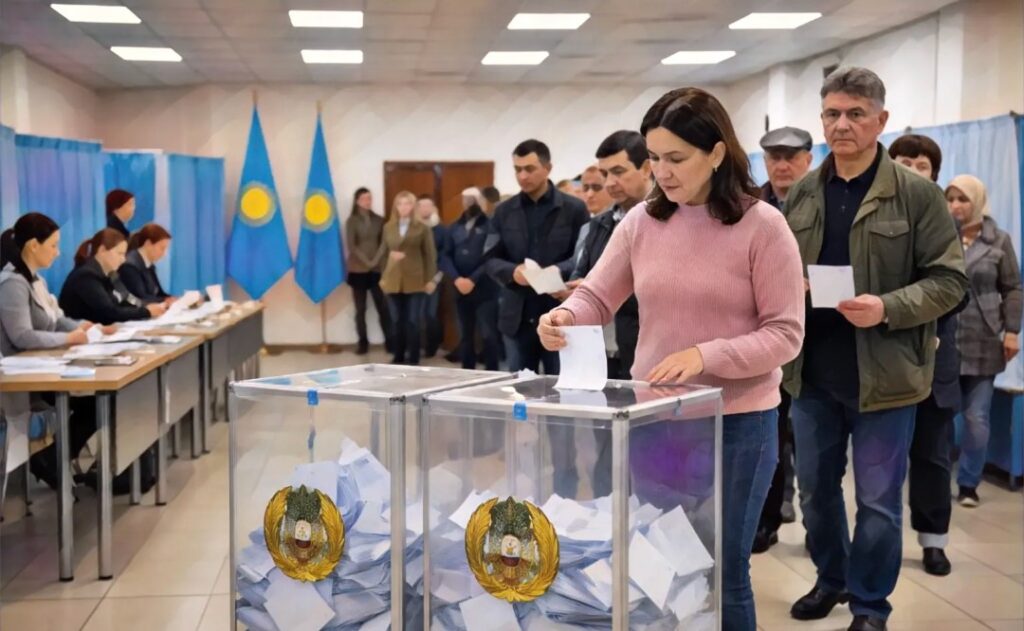
The first draft of the Basic Law was published on January 31. On February 11, a “referendum” version of the draft was presented to the president, incorporating comments received, including his own. Tokayev had outlined his remarks the previous day during an expanded government meeting. The question to be put to voters in March is: “Do you accept the new Constitution of the Republic of Kazakhstan, the draft of which was published in the mass media on February 12, 2026?”
What is particularly notable is that on September 8, the president had cautioned against haste, calling parliamentary reform a “very serious issue” and stating that rushing it would be inappropriate.
“This reform must be the subject of detailed discussion in civil society, among experts, and, of course, in the current Parliament… I believe that, given the extraordinary nature of the reform, the discussion will take at least a year, after which a nationwide referendum could be held in 2027, and then the necessary amendments could be made to the Constitution,” Tokayev said at the time.
A little over five months later, however, the country is preparing for changes that extend beyond the initial proposal to abolish the upper house.
At a government meeting, Tokayev emphasized that “no one is setting the task of negating the significance of the current Constitution, which has played a huge role in all of our country’s achievements over the past 30 years.
“Nevertheless, it should be noted that it was adopted when our country was just getting on its feet and bears the imprint of the first difficult years of our independence. Since then, our society has changed significantly. Today, fundamental geopolitical, geo-economic, and technological shifts are taking place in the world. In recent years, Kazakhstan has also undergone major changes that have influenced national identity and, one might even say, caused significant upheaval. Therefore, it is extremely important for us to update our goals, values, and principles, as well as to enshrine them at the constitutional level,” he said.
He also pointed to international developments that may have influenced the pace of reform.
“Protectionism, tariff restrictions, and deglobalization are on the rise. These and other negative economic trends have already changed the geopolitical configuration, but the main events are yet to come,” the president said.
Earlier, political scientist Marat Shibutov, a member of the Constitutional Commission, addressed the issue on his Telegram channel. According to Shibutov, he is often asked why Kazakhstan is changing its Constitution.
“In my opinion, the answer is simple: dangerous and unstable times call for a different political system, described in a different constitution. The international situation does not inspire optimism,” he wrote.
As an analogy, Shibutov cited Russia’s political system, noting that if something were to happen to Vladimir Putin, Prime Minister Mikhail Mishustin would become the head of state.
“Do you think the Russian elite would agree to this or not? The fate of the current Constitution of the Russian Federation depends on the answer to this question,” Shibutov remarked.
Political scientist Daniyar Ashimbayev offered a similar line of reasoning. He noted that one of the central criticisms of the draft Constitution concerns a provision relating to international treaties, which some critics have interpreted as signaling that Kazakhstan may refuse to fulfill certain international obligations, including those connected to human rights.
Under the current 1995 Constitution, ratified international treaties have priority over domestic laws. The draft Constitution removes this explicit clause and instead states that the procedure for the application of international treaties within Kazakhstan will be determined by national legislation. Ashimbayev argues that this shift reflects a broader effort to rebalance the relationship between international and domestic law.
According to Ashimbayev, the 1995 Constitution was adopted during a period of post–Cold War optimism, when international legal norms appeared stable and widely respected. In recent decades, he contends, international law has been eroded, ignored by major powers, and increasingly used as a tool of geopolitical pressure. From this perspective, the central concern is protecting national sovereignty and ensuring stable development.
Tokayev has positioned himself as the architect of reform, presenting the new constitutional framework as a barrier against a return to personality-driven politics. Whether the accelerated timetable ultimately strengthens the reform effort will depend less on the speed of adoption than on the consistency of implementation.
By anchoring political change in constitutional revision rather than informal arrangements, the authorities are attempting to shift the center of gravity from personalities to procedures. If institutional safeguards take hold and avenues for participation expand, the current reset could mark a structural transition rather than a tactical adjustment. The referendum will therefore serve not only as a vote on a new text, but as a test of whether Kazakhstan can strengthen the institutional processes through which political authority is exercised.