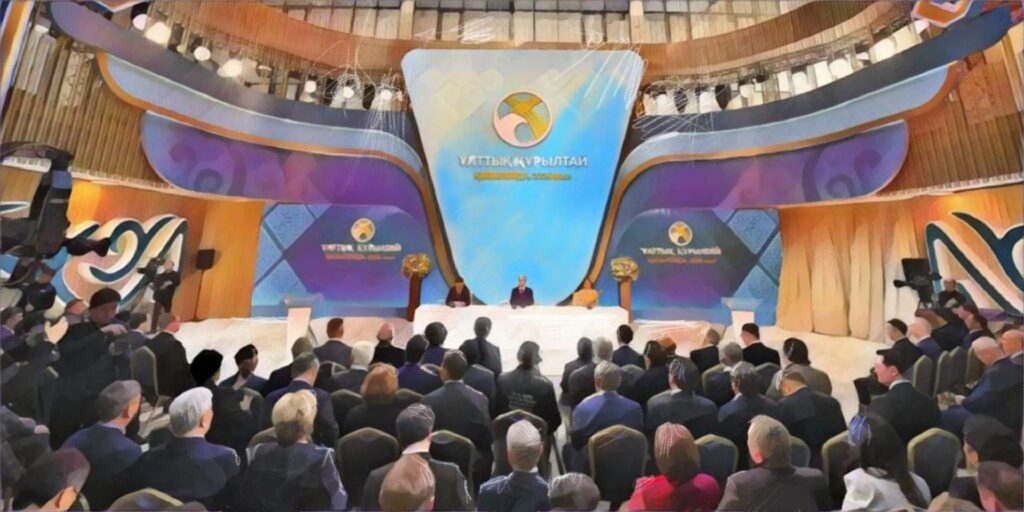
Tokayev Proposes a New Constitutional Architecture

In mid-January 2026, President Kassym-Jomart Tokayev moved Kazakhstan’s parliamentary reform agenda onto a deeper constitutional track. He framed the emerging package as comparable, in substance, to adopting a new constitution rather than making a bounded set of amendments. He also presented it as a further move away from the institutional logic of the 1995 framework and as the logical next step after the 2022 referendum changes, with the legislative branch identified as the main site of redesign.
Tokayev laid out a two-stage pathway. First, a Constitutional Commission of more than 100 members is to consolidate proposals and draft a coherent text. The work is organized through the Constitutional Court leadership, and the participant pool is expected to include representatives of the National Kurultai, legal experts, media figures, maslikhat chairs, and regional public councils. The commission was established by decree shortly after Tokayev’s public rollout of the initiative, with early reporting identifying its chair and senior officers as part of the process’ initial institutionalization.
Second, the resulting draft is to be submitted to a nationwide referendum, with timing to be set once the commission produces an implementable package. This is an architecture exercise before it is a policy program. The direction is clear enough to describe, but the operative meaning will depend on still-undetermined details, including how headline concepts are translated into constitutional language and how the referendum track shapes that drafting process.
The Kurultai Plan and the Lawmaking Design
Tokayev’s central institutional move is to abolish the current bicameral parliament and replace it with a single chamber, the Kurultai, combining functions now divided between the Mazhilis and the Senate. The change is publicly presented as consolidation, with unicameralism framed as a simplification of legislative structure that still keeps parliament as the focal representative institution within a presidential system.
The package also sketches a streamlined internal design. Tokayev stated that the new chamber should comprise 145 deputies, with up to three deputy speakers and no more than eight committees. Public reports on the working-group discussions remark that earlier concepts ranged more widely before converging on 145; the current Mazhilis and Senate total 148 members. Tokayev indicated that deputies would be elected by proportional representation at the national level, while majoritarian rules would be retained at the regional level. He also signaled the removal of quota and appointment mechanisms associated with the existing system, including the elimination of a small number of presidentially appointed seats.
A unicameral legislature raises a predictable design problem. Consolidation can increase legislative throughput unless procedures are structured to preserve deliberation. Allies of the reform have therefore emphasized a shift to a three-reading format, presented as a way to make lawmaking more deliberative. In practice, the decisive criteria here are implementation choices that are not yet public. These include final electoral rules, the internal allocation of committee jurisdiction, and procedural requirements governing readings, hearings, and amendments. Those choices will determine whether the Kurultai becomes a stronger site of relatively autonomous bargaining and scrutiny or a more efficient transmission channel for executive-initiated legislation.
Appointment Power and the Vice Presidency
Tokayev’s package does more than redesign the legislature’s internal structure. It also reallocates how key constitutional, judicial, audit, and election-management institutions are staffed. In the current system, responsibilities for the formation of the Constitutional Court, the Supreme Audit Chamber, and the Central Election Commission are divided among the Mazhilis, the Senate, and the presidency. Under the proposed design, members of all three bodies would be appointed exclusively with the consent of Parliament. In addition, Parliament would elect all Supreme Court judges on presidential recommendation, shifting the decisive vote from the Senate to the single chamber.
The reform strengthens the legislature’s checking function in formal terms, but it does not automatically represent a transfer of substantive constraint from the executive to Parliament. The presidency would retain control over the nomination chokepoint for the Supreme Court, while parliamentary “consent” for other bodies could function as either real screening or routine ratification. Here again, the operative effects will be determined by implementing rules that are not yet public. These rules include nomination pathways, committee vetting authority, hearing requirements, voting thresholds, and the extent to which party discipline and informal executive leverage reduce parliamentary discretion.
The other main constitutional revision is the creation of a vice presidency and the associated succession rewrite. Tokayev proposes establishing the post of Vice President in the Constitution, appointed by the president with the consent of Parliament through a simple majority vote, with the scope of authority determined by the head of state. Public descriptions of expected functions include representing Kazakhstan internationally, representing the president’s interests in Parliament, and engagement with domestic and international organizations, alongside other duties assigned by the president. In parallel, Tokayev proposes removing the “remainder of term” logic for early presidential departure and requiring a new presidential election within two months. This design is presented as an unambiguous procedural script for crisis succession, tying any incoming head of state to direct electoral legitimation rather than to replacement through internal political arrangements.
From 1995 to 2026 and the Reform’s Systemic Meaning
The 1995 constitutional order consolidated a strongly presidential system with a bicameral parliament. The presidency held dominant agenda-setting authority and broad appointment prerogatives, while the Senate served as an additional institutional layer for legislation and for certain appointments and confirmations. This arrangement produced a recognizable super-presidential equilibrium even when formal “checks and balances” language remained present in the text.
The 2022 referendum package modified that equilibrium without redesigning it. It introduced constraints and symbolic breakpoints associated with the post-January 2022 reset, including the re-establishment of a Constitutional Court and other adjustments framed as reducing hyper-presidential concentration. The institutional form, however, remained bicameral, and the reform did not introduce a vice presidency or a revised crisis-succession script of the kind now proposed.
The 2026 initiative is a structural redesign. Tokayev’s team frames it as close to a new constitution, because it rewires the structure of the legislature, the appointment architecture, and the succession mechanism for early presidential departure, all at the same time. A unicameral legislature can increase Parliament’s formal leverage, but it can also shorten the route for executive-initiated legislation if party discipline is tight and agenda control remains concentrated. With proportional representation, it can lower formal entry barriers for parties, but it can also concentrate executive influence in the chamber if electoral thresholds and access to ballot-listing and media remain restrictive.
Outcomes will turn on nomination pathways and voting thresholds, and on whether oversight bodies acquire operational autonomy rather than remaining procedural formalities, regardless of how “balanced” executive–legislative relations look on paper. The vice presidency codifies succession continuity and timing while preserving presidential primacy through appointment control over the vice president’s mandate. This office can provide both executive–legislative coordination and succession continuity, but its practical significance for each will depend on staffing choices and on how the role is publicly framed.
What to Watch For
The central question is whether the new parliamentary checks are enforceable in practice against the presidential agenda and nomination control. The first visible tests will be concrete and near-term. They will appear in the first appointment cycle conducted under parliamentary consent rules, in the first high-salience audit and election-administration decisions taken by reconstituted bodies, and in the first major bill processed through the three-reading procedure. If Parliament can slow or block nominees without being bypassed, then “consent” starts to function as a real check rather than a formality; if not, the redesign will have clarified lines of responsibility while leaving the balance of power largely unchanged.
The referendum track deserves attention for a second reason. Since this redesign is being framed as a new constitutional foundation, a plebiscitary ratification can supply a distinct form of legitimacy that routine parliamentary passage cannot easily provide. That legitimacy can then be used in two directions. First, it can reinforce institutionalization by making the new rules harder to reverse in a casual manner. Second, it can actually reinforce executive primacy if the referendum is portrayed as a direct mandate for a presidency-centered model of “order.” As a result, how the Constitutional Commission publishes drafts, accepts criticism, and records dissent will matter for credibility even before formal voting takes place.
Tokayev’s professional formation as a political scientist and his international experience as a diplomat at the highest levels help explain the emphasis on institutional architecture and procedural scripting, including a clearer succession timetable. The longer-run meaning, however, will be revealed only under a successor presidency, when the interests of senior political actors are more likely to diverge than to align.