In recent years, many international writers have written books about Kazakhstan. One of these is the American author Judith Lindbergh, whose latest historical novel, Akmaral, is set on the Kazakh steppe.
TCA: The story of Akmaral is related to Central Asia, and particularly, Kazakhstan…
JL: Absolutely correct. Akmaral is about a nomadic woman warrior on the Central Asian steppes in the 5th century BCE. It’s based on archaeology that many of your readers are likely familiar with: the Siberian Ice Maiden discovered in Tuva and the Issyk Golden Warrior of Kazakhstan.
These two burials were just the beginning of my research, which also included the writings of the Greek historian Herodotus about the Amazon warrior women who fought in the Trojan War. I delved deeply into the history, landscape, and cultures of Central Asia, both ancient and modern. In writing my novel, I worked hard to understand how people lived, and still live, on the steppes: their traditional nomadic ways of herding and hunting, and especially how this ancient, often-forgotten culture fits into the broader story of human civilization.

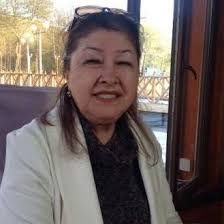
Judith Lindbergh
TCA: How did the idea to write such a novel come about?
JL: It all started with a documentary about the Siberian Ice Maiden. I love ancient history and archaeology, especially when they reveal truths about women’s lives. The Ice Maiden burial was fascinating. Her body was so well preserved that I could almost imagine her standing before me. I wanted to understand how she might have lived, and to uncover the mystery of why she was buried in such an isolated place.
As I continued my research, I realized that she was not the only important female burial from that era in Central Asia. There were, in fact, countless others. Many women who had died of war wounds were buried with weapons. I began combining these burials in my imagination to create my main character, Akmaral, which I learned means “White Deer.” The name felt connected to the Siberian Ice Maiden’s famous tattoo, which became an important spiritual symbol in my novel.
I used extensive research to try to accurately represent what life might have been like for these ancient women. In historical fiction, as in history itself, women rarely play significant roles in public life. Yet these artifacts and burials show us that many nomadic women once held important military and spiritual positions.

There are almost no works written in English about nomadic peoples, including the real life and history of the Kazakhs. In fact, nomads were people who lived freely and truly in their time. And now we are not able to glorify their values, their way of life. What do you think about this?
You’re right that there’s very little written in the West about the Sarmatians, or really much about Central Asia at all. I wanted to bring my fascination with this vital, “forgotten” part of history to new readers.
In many ways, it can be hard for modern readers to understand and appreciate the sophistication and achievements of ancient peoples, nomads in particular. But to me, the idea that the land itself is home, and that nature provides everything we need, is both a challenge and an inspiration. In the West, and in modern life more broadly, we have grown so distant from the earth. What I saw in my characters, and in ancient nomadism, is a profoundly different relationship with the land that gave us life. I wanted to honor and portray that connection through my story.
TCA: Where did you get the details for this work?
JL: Along with countless archaeological and historical sources, I drew on many nomadic cultural traditions still practiced and honored in Kazakhstan, Mongolia, and Tuva. I tried to create as authentic a depiction of nomadic culture and traditions as possible, even though the story takes place in the distant past.
I deeply admire the resilience and self-sufficiency required to live a nomadic life, both among contemporary people who still live part of the year on the steppes and the ancient peoples who survived through herding and horsemanship. I wanted my characters to be deeply connected to nature and to understand the necessity of respecting the land.
While I’m fairly certain that I don’t have the stamina or fortitude to live that way myself, through my novel and its characters, I feel I’ve absorbed at least a touch of their strength and wisdom.
TCA: Did you have any difficulty in depicting the image of a female warrior from the Sarmatian era?
JL: The hardest thing for me was imagining being a woman who could willingly kill. I’m not a violent person myself, and I have no real hunting skills. Although I did practice archery and horseback riding to get a sense of what my characters’ daily life might have been like. But I can’t imagine doing many of the things that Akmaral had to do.
She had to hunt wild animals to survive, which was frightening enough. But she also had to protect her people from enemy attacks, facing close combat and death on a regular basis. Akmaral lived in a different time and place, and the values were different. Survival on the steppes, especially in ancient times, meant guarding oneself against countless dangers: wild beasts, hunger, deprivation, drought, heat, cold, and attacks from rival tribes.
Whenever I wrote a battle scene, I would prepare myself by listening to traditional Central Asian throat singing or other music played in deep, minor tones. It helped me face the fear and gravity of battle and death. I never wanted my characters to kill frivolously.
TCA: How do readers in America and other countries respond to your work?
JL: I have been thrilled at the reception to my novel so far, both by well-known American authors and readers in the USA and around the globe. Many readers are fascinated and surprised at the rich history of Central Asia, and by the realization that these women warriors aren’t made-up fantasy characters like in Game of Thrones. My characters are based on real archaeology that proves that women were once powerful warriors and leaders in a real time and place.
TCA: Have there been any proposals to translate the novel “Akmaral” into Kazakh?
JL: I’ve had a lot of interest and many requests for translations, including several conversations with Kazakh natives who either live in the U.S. or read English. I’m so grateful to hear that my research and imagination hold up against their real-life experiences and knowledge of the landscapes and cultures I tried to bring to life. But so far, no translation has been made.
I would love for a publisher in Kazakhstan to reach out to me or my publisher. The people who would truly understand my novel with all their hearts live in your country and region.
TCA: What do you know about Kazakh literature?
JL: A little. I’ve read one or two novels in translation, thanks to recommendations from Kazakh readers who reached out to me. Right now, I’m reading “Ulpan Is Her Name” by Gabit Musirepov, thanks to one of them. I know there is much more literature that I can’t yet access because I don’t read Kazakh, but I look forward to discovering more works in translation.
Sharing literature across languages is a powerful way to create compassion, understanding, and appreciation for our different cultures and for our shared humanity.