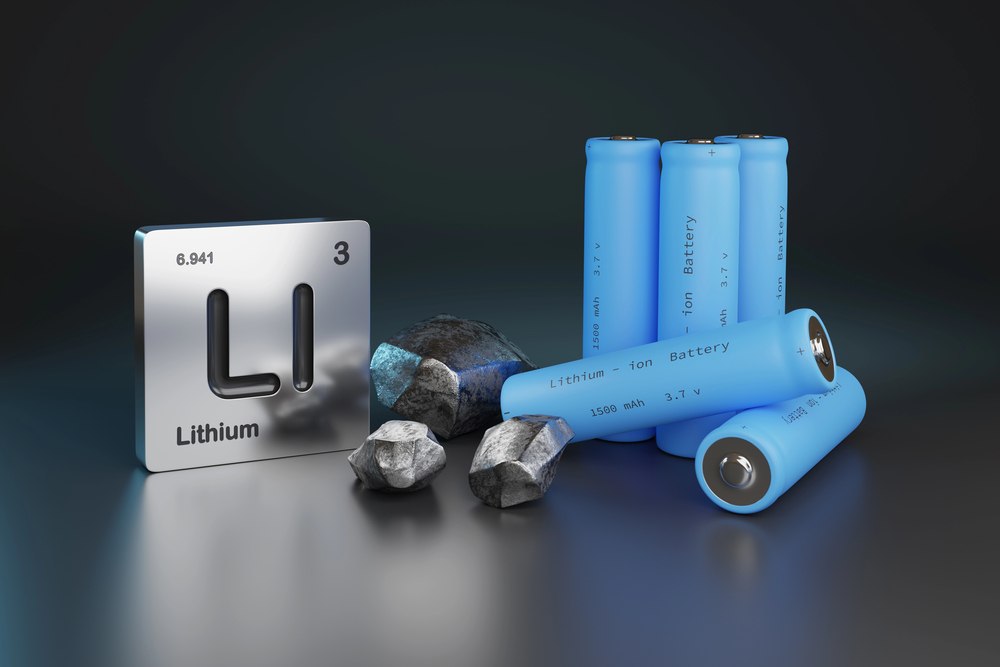
Tajikistan plans to launch a lithium mining project at the Namadgut deposit in the Ishkashim district of the Gorno-Badakhshan Autonomous Region within the next year, according to Minister of Industry and New Technologies Sherali Kabir.
Around 80% of the equipment required for the project has already been delivered to Tajikistan, while substantial geological exploration has been carried out at the deposit. That said, the government has not disclosed the size or grade of its lithium reserves, nor the project’s expected output or cost.
The Namadgut deposit also contains niobium, tantalum, and beryllium, in addition to lithium, according to Kabir.
Niobium is mainly used to strengthen steel and in heat-resistant alloys for aircraft engines and other high-temperature equipment. Tantalum is used in compact electronic capacitors, including those found in phones and computers, as well as in aircraft-engine alloys. Beryllium is used in lightweight, high-strength components for the aerospace, electronics, and nuclear industries.
Although global lithium prices recovered from their 2025 lows during early 2026, they remain around 70% below their 2022 peak. Kabir acknowledged that this fall in prices but argued that the presence of other valuable metals, whose prices may be more stable, could improve the project’s commercial prospects.
The minister also believes that developing Tajikistan’s lithium industry could help attract major international companies involved in electric vehicle and battery production.
“An electric vehicle requires aluminum for the body, copper for the wiring, and lithium batteries as a key component. We have these resources,” Kabir said.
According to the minister, the development of lithium production could create opportunities for Tajikistan to establish higher value-added industries rather than limiting itself to raw-material exports.
The Namadgut project forms part of a broader effort to develop Tajikistan’s critical-minerals sector. In 2024, officials reported the discovery of 15 new deposits of rare metals, including lithium, according to Mukhtor Fozilzoda, head of the geology department at Tajikistan’s Main Directorate of Geology.
The deposits were identified in remote eastern areas, including Karasu, Agbasoy, Payron, and Rokhshif. Despite difficult terrain and harsh natural conditions, officials say advances in exploration technology have made it possible to study these regions more effectively.
Fozilzoda said the discoveries could support the expansion of the mining industry, create jobs, and provide raw materials for battery manufacturing and other high-technology sectors.
Kabir previously said Tajikistan intended to become the first country in the Commonwealth of Independent States to establish lithium production.
According to the minister, Tajikistan possesses reserves of 10 of the 12 metals considered critical for the global green transition, with six already being produced domestically.
Critical minerals are essential for renewable-energy technologies, including solar and wind power systems, electric vehicles, and battery storage.
Kabir added that during the Soviet period, only three enterprises produced what he described as rare-earth metals, two of which were located in Tajikistan. Public accounts more clearly document Tajikistan’s Soviet-era role in uranium and broader rare-metal processing, particularly at the Leninabad Mining and Chemical Combine, now known as Vostokredmet. The government is now negotiating with international companies on modernizing its Soviet-era processing facilities.