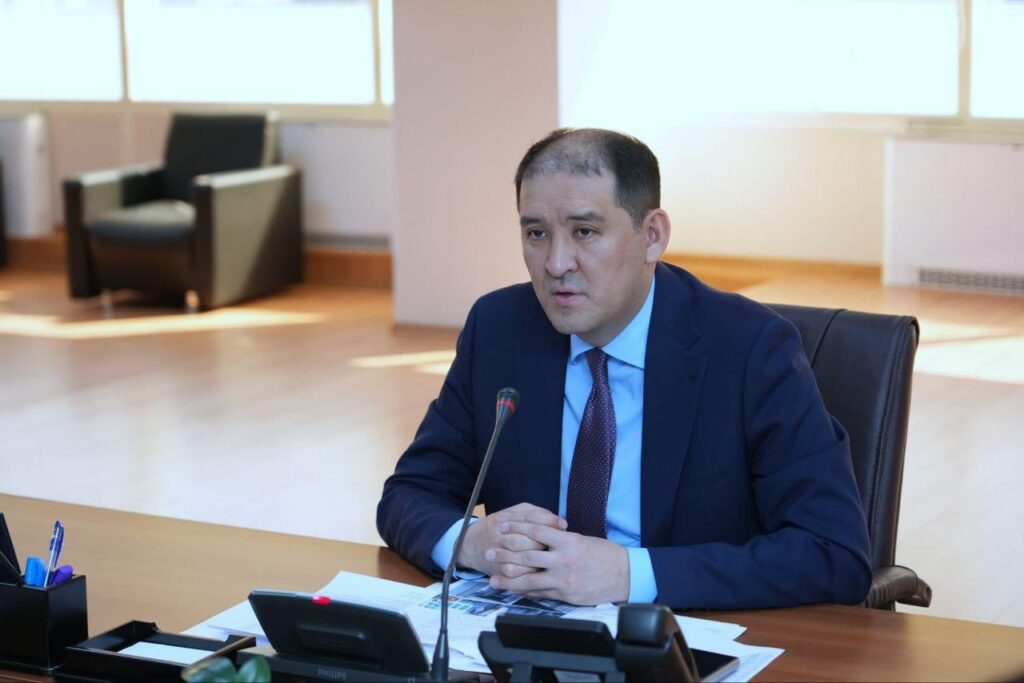
A stronger monetary-policy framework, a resilient banking sector, and closer coordination with the government were among the strengths recognized in S&P Global Ratings’ upgrade of Kazakhstan, National Bank Governor Timur Suleimenov told The Times of Central Asia.
“S&P’s upgrade of Kazakhstan’s sovereign credit rating from ‘BBB-’ to ‘BBB’ is an important external assessment of the resilience of our economy amid continued global uncertainty and commodity market volatility,” Suleimenov said.
On August 21, S&P raised Kazakhstan’s long- and short-term sovereign credit ratings to BBB/A-2 from BBB-/A-3. The stable outlook reflects S&P’s view that Kazakhstan’s ample fiscal and external buffers should help it absorb external shocks, while the non-oil budget deficit is expected to narrow further. Kazakhstan last held the BBB rating before S&P downgraded it in February 2016.
Kazakhstan now carries the same BBB long-term sovereign rating as India, Indonesia and Greece. It stands one notch above Hungary, Oman and Serbia at BBB-, and one below Bulgaria and Italy at BBB+. The comparison concerns credit risk rather than economic size or development.
Why S&P Moved Now
S&P expects Kazakhstan’s economy to grow by 5.1% in 2026 and by around 4% to 4.5% annually in 2027–2029, a pace it says exceeds that of peer countries. It also expects a broader tax base, tighter expenditure controls and reduced quasi-fiscal activity by major state-owned enterprises to improve the country’s fiscal position.
Stricter rules governing National Fund withdrawals are intended to preserve the assets available to absorb commodity-price falls and other external shocks. According to the National Bank’s account of the decision, S&P also highlighted Kazakhstan’s substantial foreign-currency reserves and strong external position.
A Stronger Monetary Framework
“We particularly welcome the agency’s recognition of the strengthening of Kazakhstan’s monetary policy framework and the resilience of the banking sector to macroeconomic shocks,” Suleimenov said.
Suleimenov had outlined that policy course in earlier interviews with TCA. In April, he described tighter monetary conditions alongside government fiscal consolidation, while in June, after the Bank cut its base rate from 18% to 17%, he cautioned that inflation had not been defeated and said further moves would depend on incoming data.
Annual inflation declined from 11% in March to 10.2% in July. S&P cited a stronger monetary-policy framework, closer government-National Bank coordination, fiscal consolidation, reduced quasi-fiscal activity and tighter macroprudential regulation. It also described the banking sector as resilient, with adequate capital and liquidity buffers.
The National Bank’s response went beyond the base rate. It increased minimum reserve requirements, used operations linked to gold purchases to absorb excess liquidity and supported measures to slow unsecured consumer lending. The Bank lowered the rate again to 16.75% in July as inflation eased.
Even so, inflation remains more than double the National Bank’s medium-term target of 5%. S&P’s assessment recognizes the strengthening of the monetary-policy framework, not the end of Kazakhstan’s inflation problem.
“Enhanced coordination between the Government and the National Bank, together with the continued improvement of regulation and supervision, is contributing to stronger macroeconomic and financial stability,” Suleimenov said.
Fiscal Reform and National Fund Discipline
The National Bank’s actions form one part of a broader economic reform program pursued under President Kassym-Jomart Tokayev, combining tighter fiscal discipline, changes to taxation and budgeting, and greater restraint in the use of National Fund resources. Monetary policy falls principally within the Bank’s mandate. Fiscal reform has required decisions by Tokayev, the government and Parliament.
Tokayev has called for Kazakhstan to “live within its means,” end inefficient use of National Fund resources and restrict transfers to critical infrastructure and nationally important projects. His government has also moved to limit expenditure growth, while Tokayev has pressed for reform of the heavily indebted quasi-public sector.
In June, Tokayev said the new Budget and Tax Codes had transformed the management of public finances and laid the foundation for a new economic model. S&P had previously said a broader tax base, tighter spending controls and reduced reliance on National Fund transfers would strengthen Kazakhstan’s fiscal position. In its new assessment, S&P cited progress in those areas, alongside reduced quasi-fiscal activity and stricter National Fund rules.
Several of the reforms emphasized by Tokayev correspond directly with the areas S&P identified as strengthening Kazakhstan’s credit profile.
Alongside the National Bank’s restrictive monetary stance, tighter spending controls, a broader revenue base and reduced reliance on National Fund transfers are bringing fiscal and monetary policy into closer alignment. S&P’s assessment indicates that these changes have strengthened Kazakhstan’s economic and financial stability and resilience to external shocks.
Kazakhstan’s Regional Advantage
TCA’s Central Asia Balance Sheet shows Kazakhstan with the largest GDP and inward foreign direct investment stock among the five Central Asian economies. Its charts also place Kazakhstan in the region’s strongest sovereign-risk position.
Before the August 21 decision, Kazakhstan was already the only Central Asian sovereign rated investment grade by a major international rating agency. Its previous BBB- rating sat at the lowest investment-grade level. The move to BBB takes it farther above that threshold and widens the ratings gap with its regional peers.
S&P identified Kazakhstan’s ample fiscal and external buffers as one of the strengths supporting the upgrade. A separate measure in the Balance Sheet illustrates that advantage regionally. Kazakhstan’s international reserves and eligible stabilization assets cover public and government-guaranteed external debt 3.8 times, based mainly on 2023–2024 data. That is the highest ratio among the Central Asian states for which comparable data are available.
The upgrade does not remove the country’s vulnerabilities. Inflation remains high, hydrocarbons account for a large share of output, government revenue and exports, and the concentration of oil exports through the Caspian Pipeline Consortium leaves the economy exposed to infrastructure disruption and geopolitical spillover. High domestic interest rates have also increased government borrowing costs.
“The upgrade is also a positive signal for international investors and financial markets,” Suleimenov said. “Our priority remains to bring inflation back to target, safeguard price and financial stability, and further strengthen confidence in Kazakhstan’s economic policy.”