Kazakhstan has spent years looking for more ways to export its oil without relying so heavily on Russia. This summer has shown how difficult that remains. Shipments to Germany through the Druzhba pipeline have been suspended since May, disruptions on the Black Sea in July forced Tengiz to more than halve production, and now Russia is rerouting Kazakh crude from Ust-Luga to Novorossiysk to free Baltic capacity for its own oil. The shift comes as exports from Russia’s western ports ran 15% below plan in the first half of August, with Novorossiysk shipments of Russian Urals and Kazakh KEBCO falling to around 400,000 barrels per day.
At least two cargoes of Kazakhstan’s KEBCO crude scheduled for loading at Ust-Luga in late August will instead be shipped through the Black Sea. No KEBCO loadings are currently planned at the Baltic port in September. The move will free up about 100,000 barrels per day of export capacity at Ust-Luga for Russian crude. Kazakh producers support the arrangement because shipments through Novorossiysk are currently more profitable.
From a commercial standpoint, the decision is understandable. But Ust-Luga and Novorossiysk give Kazakhstan access to two different seas while remaining Russian ports. And Novorossiysk, where the KEBCO cargoes are now being redirected, had itself suspended crude loadings only a few days earlier.
On August 14, loadings at the Sheskharis terminal, Novorossiysk port’s main oil-export facility, were halted following a drone attack. The facility handles around 700,000 barrels per day and loads Russian Urals and Siberian Light as well as Kazakhstan’s KEBCO. Operations resumed on August 16, and one of the first tankers to load was carrying Kazakh crude. Another 80,000-ton KEBCO cargo was due to begin loading on August 18.
Kazakhstan’s far larger vulnerability, however, is the Caspian Pipeline Consortium. Its marine terminal near Novorossiysk is separate from Sheskharis. In 2025, the country exported 78.7 million metric tons of oil, of which 64.8 million tons were shipped through CPC. Volumes through the pipeline rose by 18% compared with 2024, largely as production increased following the Tengiz expansion.
The July disruptions showed how quickly problems on that route can affect production inside Kazakhstan. After drone attacks near the CPC terminal forced restrictions on loadings, Kazakhstan’s oil and gas condensate production fell by about 21% by July 22 to roughly 1.63 million barrels per day, from a July average of 2.07 million barrels per day. Tengiz output dropped from a July average of around 925,000 barrels per day to about 406,000.
A few days later, the situation deteriorated further. On July 26, Kazakhstan produced around 1 million barrels per day of oil and gas condensate, down from an average of 2.16 million barrels per day in June. Tengiz, Kashagan, and Karachaganak all had to reduce production. On July 27, CPC resumed loadings after a week-long suspension.
CPC accounts for more than 80% of Kazakhstan’s oil exports, so replacing it quickly with other routes is impossible. The pipeline typically carries around 1.5 million to 1.7 million barrels per day. When its Black Sea terminal stops operating, Kazakhstan simply does not have spare export capacity on that scale.
Astana acknowledges this. On May 29, Energy Minister Yerlan Akkenzhenov said there was currently no full-fledged alternative to CPC and that Kazakhstan viewed all other routes as supplementary rather than replacements. The CPC system can carry about 72.5 million tons a year from Kazakhstan and up to 83 million tons annually across Russian territory.
Kazakhstan has, however, learned to spread additional volumes among several routes. When CPC faced another round of restrictions in late 2025, Kazakhstan increased shipments through alternative routes, including toward China and through Baku-Tbilisi-Ceyhan, while continuing to use Russian ports and the Druzhba route to Germany.
The German route looked particularly promising for a time. Kazakhstan began supplying crude to the Schwedt refinery in 2023. Shipments reached 2.146 million tons in 2025, and about 3 million tons had been planned for 2026. But the oil reached Germany through Russia’s Druzhba pipeline.
Russia suspended the transit of Kazakh crude toward Germany from May 1, citing technical constraints. Kazakhstan had shipped 1.02 million tons there between January and April. In July, the Energy Ministry said there would be no deliveries in either July or August.
Those volumes could be redirected elsewhere. Their relatively small size illustrates the difference between Druzhba and CPC: Kazakhstan can relatively quickly reroute one or two million tons a year. It does not have the same flexibility for the tens of millions of tons shipped through CPC.
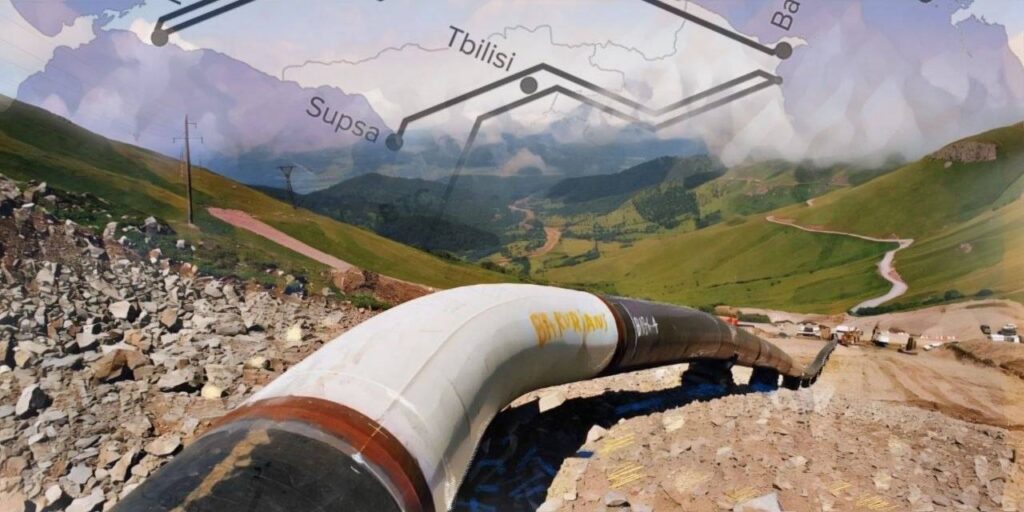
The route that genuinely gives Kazakhstan access to European buyers without crossing Russian territory runs across the Caspian Sea. Oil is delivered to Aktau, shipped by tanker to Azerbaijan, and then sent through the Baku-Tbilisi-Ceyhan (BTC) pipeline, which crosses Azerbaijan, Georgia, and Turkey before reaching the Mediterranean coast at Ceyhan.
The volumes are on a completely different scale, however. Kazakhstan shipped around 1.2 million tons through the BTC route in 2025. Azerbaijan has said it is prepared to receive up to 2.2 million tons of Kazakh oil annually. Kazakhstan has been seeking to increase volumes along this corridor.
Even 2.2 million tons is difficult to compare with the 64.8 million tons shipped through CPC last year. Scaling up the Caspian route quickly is also difficult: the oil must first reach Aktau, be loaded onto tankers, cross the Caspian, and then be transferred again in Azerbaijan. Higher volumes require additional port capacity and tanker availability.
Kazakhstan can also send oil east toward China and, in smaller volumes, by rail. In August, Tengizchevroil planned to ship about 100,000 metric tons of oil by rail to Georgia’s Black Sea port of Batumi. With CPC loadings repeatedly disrupted, even the more expensive rail route became attractive again.
The risks extend beyond Kazakhstan. CPC carries about 1.8% of global oil supply, and Kazakhstan’s largest fields are operated by companies including Chevron, ExxonMobil, Eni, and other Western majors.
Kazakhstan has added more ways to move oil, but it has not yet added another route capable of handling anything close to CPC volumes. BTC, China, Druzhba, and rail can absorb individual cargoes or several million tons a year; a prolonged CPC disruption still means cutting production.