A notable strategic shift is taking place in U.S. foreign policy, one that could have a long-term impact on the economic architecture of Eurasia. After decades in which Central Asia and the South Caucasus were viewed largely through the lens of security, counterterrorism, and competition with Russia and China, Washington is increasingly emphasizing trade, investment, transport routes, and access to critical minerals.
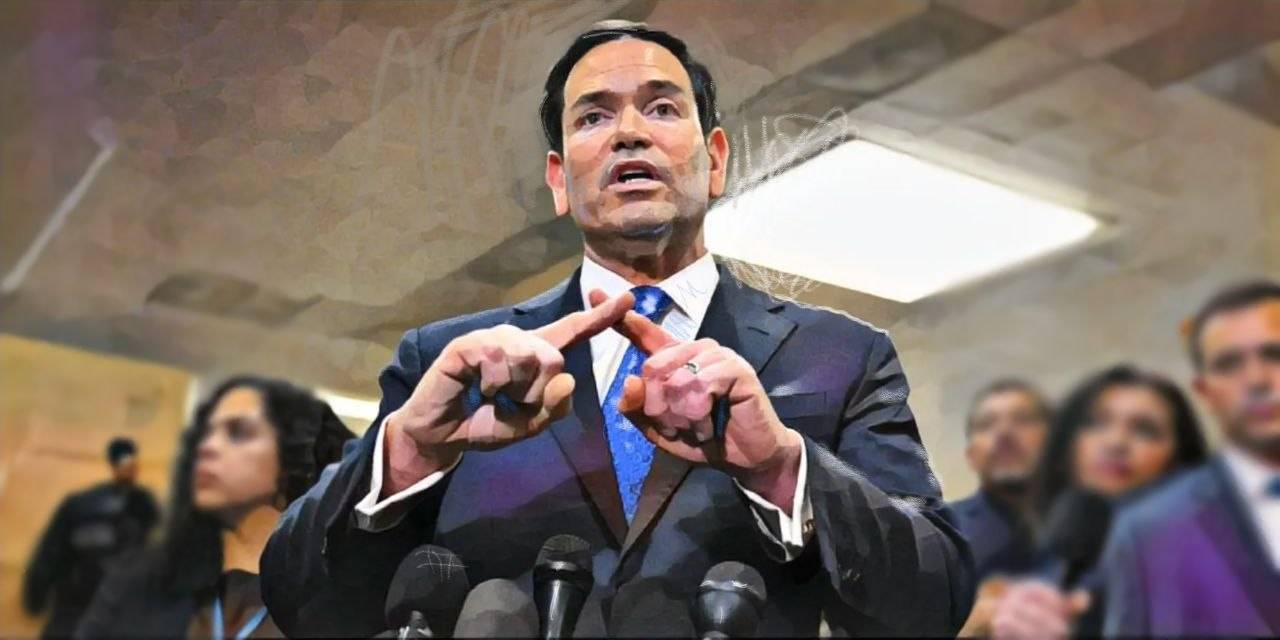
One of the clearest signs of this shift came during a recent hearing before the U.S. Senate Foreign Relations Committee, where Senator Steve Daines and Secretary of State Marco Rubio discussed the implementation of the U.S.-backed Trump Route for International Peace and Prosperity (TRIPP) framework, as well as the need to remove the outdated Jackson-Vanik trade restrictions.
At first glance, these may appear to be separate issues: the peace process in the South Caucasus and Cold War-era trade legislation. In reality, however, they are closely connected. Together, they point to a broader U.S. effort to link Central Asia, the South Caucasus, and Western markets through trade, transport, and investment.
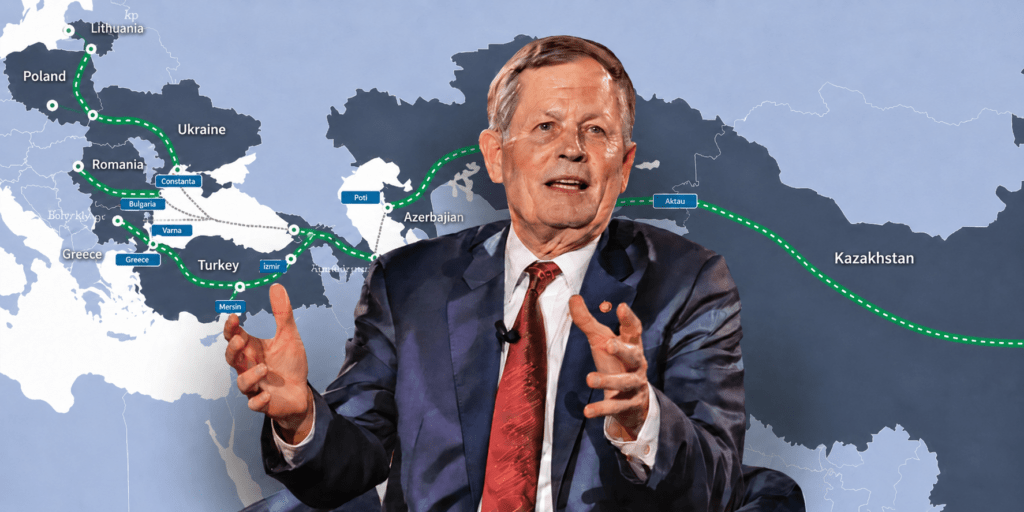
In recent years, Republican Senator Steve Daines of Montana has emerged as one of the most active advocates of expanding America’s presence in Central Asia. As co-chair of the Senate Central Asia Caucus and one of the leading proponents of legislative efforts to repeal Jackson-Vanik restrictions, Daines has consistently argued for stronger trade and investment ties between the United States and the countries of the region.
During the hearing, Daines placed particular emphasis on the importance of the Armenia-Azerbaijan peace process, describing it as one of the most underappreciated diplomatic efforts of recent years. According to the senator, resolving the conflict could open the door to a large-scale economic transformation of the wider region.
Particularly noteworthy was his reference to a geopolitical concept associated with former U.S. National Security Advisor Zbigniew Brzezinski. In Daines’ formulation, Central Asia represents the “bottle,” while Azerbaijan serves as its “cork.” Opening transport routes through the South Caucasus, he argued, would allow flows of oil, gas, critical minerals, and other resources to move toward Western markets rather than toward Russia, China, or Iran.
Daines said this approach helped address some of the most difficult issues in the Armenia-Azerbaijan settlement process and laid the foundation for what he called a “landmark agreement” after nearly four decades of conflict.
Secretary of State Marco Rubio described TRIPP as an initiative capable of fundamentally transforming Armenia’s economic role in the region. According to Rubio, the framework not only addresses the issue of transport access, which had long been a source of disagreement between Baku and Yerevan, but also creates an opportunity for Armenia to become a major trade and logistics hub connecting Europe and Asia.
Rubio described TRIPP as central to the Armenia-Azerbaijan settlement framework, emphasizing that the project could generate substantial investment flows and attract U.S. companies to infrastructure and transport projects across the region.
Washington’s argument is that trade, transit, investment, and infrastructure can give the political settlement a stronger economic base.
Unlike many previous peace initiatives, TRIPP is built around tangible economic incentives: trade, transit, investment, and infrastructure development. It is within this broader strategy that the question of repealing the Jackson-Vanik amendment acquires new significance.
The amendment was adopted by the U.S. Congress in 1974 as a means of pressuring the Soviet Union and other non-market economies that restricted freedom of emigration. The law denied such countries most-favored-nation trade status and imposed additional trade restrictions.
Despite the collapse of the Soviet Union more than three decades ago, the amendment formally remains in effect for several post-Soviet states, including Kazakhstan, Uzbekistan, Tajikistan, Turkmenistan, and Azerbaijan. Although most of these countries receive annual waivers and effectively enjoy normal trade relations with the United States, the legislation itself remains on the books.
At the hearing, Daines described Jackson-Vanik as one of the principal irritants in U.S. relations with both Azerbaijan and the countries of Central Asia. The senator argued that the restrictions have long since lost their original relevance and continue to impede the development of economic ties.
Rubio’s response when asked about the Jackson-Vanik amendment was unequivocal.
“It’s a detriment. We’d like to see it removed,” the Secretary of State said.
Kazakhstan’s ambassador to the United States, Magzhan Ilyassov, welcomed the exchange.
“U.S.-Kazakhstan relations are at new heights and your engagement with Central Asia has played a pivotal role in that progress,” Magzhan Ilyassov said on X.
He said that removing the “relic” of the Jackson-Vanik amendment would support “the new chapter in the partnership.”
For many American policymakers, the issue has long ceased to be merely a trade matter. Today, Jackson-Vanik is increasingly viewed as a symbolic reminder that U.S. policy toward Central Asia still relies in part on instruments inherited from the Cold War era.
For business, the issue is certainty. Major investment projects in mining, energy, transport infrastructure, and manufacturing are planned over decades. If normal trade relations depend on annual waivers, companies face an added layer of political and regulatory risk.
This is why Congress regularly sees initiatives aimed at granting Kazakhstan, Uzbekistan, and other Central Asian states permanent normal trade relations status. In recent years, such initiatives have attracted support from both Republicans and Democrats.
That leaves Washington with a policy contradiction: it is encouraging American companies to invest billions of dollars in the region while maintaining legislative restrictions adopted more than half a century ago for an entirely different geopolitical era.
The principal driver of growing U.S. interest in the region remains the desire to diversify global supply chains and reduce dependence on China. Today, Beijing occupies a dominant position in the production and processing of rare earth elements that are essential for batteries, semiconductors, defense products, and technologies associated with the energy transition.
According to available estimates, approximately 170 rare earth deposits have been identified across the region. Kazakhstan possesses substantial reserves of tungsten, uranium, and other strategic metals, while Uzbekistan is actively attracting foreign investors to projects involving the extraction and processing of mineral resources.
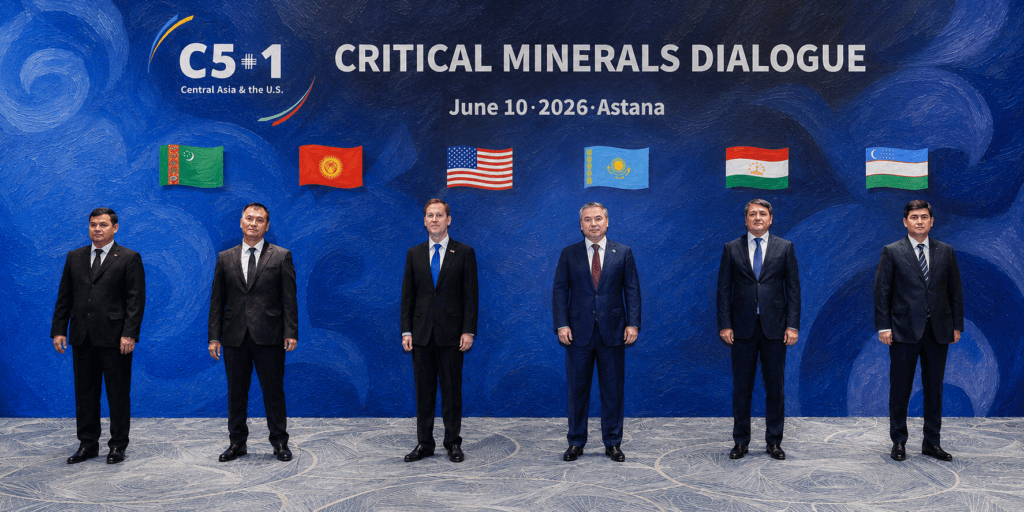
At the C5+1 Summit in Washington in November 2025, Kazakhstan signed agreements with American companies worth approximately $17 billion in aviation, digital technologies, and critical minerals. Uzbekistan also concluded major commercial agreements in the aviation and energy sectors.
These projects suggest that Washington increasingly views Central Asia not as a temporary foreign policy priority, but as a long-term component of its economic security strategy.
Despite growing U.S. engagement, competition in the region remains intense. China remains Central Asia’s largest single-country trading partner, while the EU is also one of the region’s main trade and investment partners. In 2025, trade between China and the countries of the region reached $106.3 billion. By comparison, trade between the United States and Kazakhstan, Washington’s largest partner in Central Asia, stands at approximately $5.5 billion.
Moreover, governments in the region have increasingly pursued multi-vector foreign policies and have shown little interest in choosing openly between Washington, Moscow, and Beijing. This means that attitudes in Central Asia and the South Caucasus depend far less on high-profile political statements than on the ability to offer real investment, technology, financing, and infrastructure solutions.
The hearing featuring Daines and Rubio was therefore a revealing moment in understanding how Washington’s view of Eurasia is evolving.
In that sense, TRIPP and Jackson-Vanik repeal now sit in the same policy frame. One is meant to open new trade and logistics routes. The other would remove a Cold War-era barrier that still complicates American business engagement across the region.