• KGS/USD = 0.01144 0%
  • KZT/USD = 0.00196 -0%
  • TJS/USD = 0.10899 -0%
  • UZS/USD = 0.00008 -0%
  • TMT/USD = 0.28490 0%
  • KGS/USD = 0.01144 0%
  • KZT/USD = 0.00196 -0%
  • TJS/USD = 0.10899 -0%
  • UZS/USD = 0.00008 -0%
  • TMT/USD = 0.28490 0%
  • KGS/USD = 0.01144 0%
  • KZT/USD = 0.00196 -0%
  • TJS/USD = 0.10899 -0%
  • UZS/USD = 0.00008 -0%
  • TMT/USD = 0.28490 0%
  • KGS/USD = 0.01144 0%
  • KZT/USD = 0.00196 -0%
  • TJS/USD = 0.10899 -0%
  • UZS/USD = 0.00008 -0%
  • TMT/USD = 0.28490 0%
  • KGS/USD = 0.01144 0%
  • KZT/USD = 0.00196 -0%
  • TJS/USD = 0.10899 -0%
  • UZS/USD = 0.00008 -0%
  • TMT/USD = 0.28490 0%
  • KGS/USD = 0.01144 0%
  • KZT/USD = 0.00196 -0%
  • TJS/USD = 0.10899 -0%
  • UZS/USD = 0.00008 -0%
  • TMT/USD = 0.28490 0%
  • KGS/USD = 0.01144 0%
  • KZT/USD = 0.00196 -0%
  • TJS/USD = 0.10899 -0%
  • UZS/USD = 0.00008 -0%
  • TMT/USD = 0.28490 0%
  • KGS/USD = 0.01144 0%
  • KZT/USD = 0.00196 -0%
  • TJS/USD = 0.10899 -0%
  • UZS/USD = 0.00008 -0%
  • TMT/USD = 0.28490 0%
08 December 2025

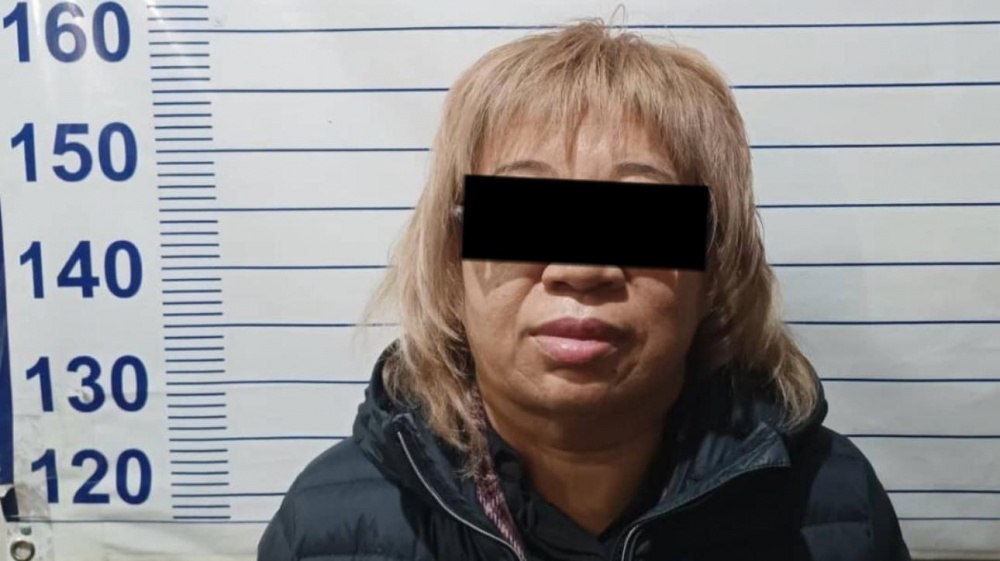
Kyrgyz Politician Irina Karamushkina Detained on Suspicion of Offering Cash for Votes

Irina Karamushkina, a senior member of the Social Democrats party and a former deputy of Kyrgyzstan’s Parliament, the Jogorku Kenesh, has been detained in Bishkek on suspicion of buying votes ahead of local elections on November 17. The Social Democrats are one of about 20 parties whose candidates are registered in the elections.

According to the press service of the city’s police department, on November 13 an audio recording surfaced on social media in Kyrgyzstan, in which the chief of staff of the Social Democrats party, identified as “I.K.”, allegedly discussed vote buying with a person named “D.C.” ahead of Sunday’s elections.

In response, Bishkek police investigators launched a criminal case under Article 196 of the Kyrgyz Criminal Code, addressing election bribery. Later, the police distributed an audio recording allegedly capturing a conversation between Karamushkina and Daniyar Cholponbaev — the party’s candidate for deputy — where they appear to discuss offering bribes for votes.

The investigation found that “T.R.”, a trustee of the Social Democrats, and “I.K.” were involved in voter bribery, offering 1,000 Kyrgyz som ($12) per vote. During a search of the party headquarters, authorities seized lists indicating payments of 15,000 to 30,000 som ($175 to $350) to over 40 individuals, along with 28,300 som ($330) in cash, believed to be intended for offering bribes to voters.

“T.R.” and “I.K.” were detained as suspects and are being held in a temporary detention facility. The investigation is ongoing.
On November 13, police and special forces raided the Social Democrats’ headquarters, evacuating everyone from the premises. Party leader Temirlan Sultanbekov was taken in for questioning, and Karamushkina’s residence was also searched as part of the investigation.

Government Reports Steady Economic Growth in Kyrgyzstan

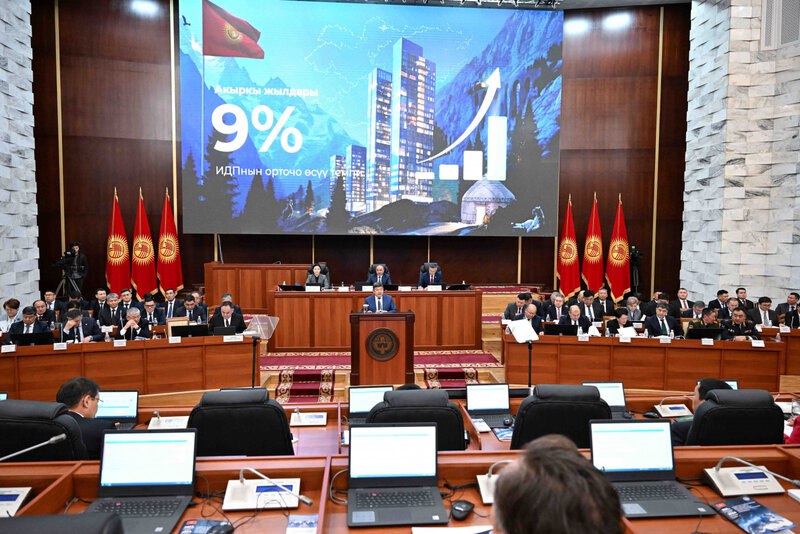
Chairman of the Cabinet of Ministers Akylbek Japarov announced in parliament on November 14 that Kyrgyzstan’s GDP exceeded a historical high of 1.3 trillion KGS in 2023 and is projected to reach 1.5 trillion KGS ($17.35 billion) by the end of the year. Presenting the state budget execution for 2023 and the draft budget for 2025, Japarov reported a 9% real GDP growth rate for 2023, consistent with the growth rate in 2022. For context, Kyrgyzstan’s GDP growth was 7% in 2021.

Japarov offered a conservative forecast for 2024, predicting 9.2% GDP growth. “If we divide GDP per capita, then in 2020, this figure was $1,200, and in 2024, it will exceed $2,500,” he noted. The average monthly wage in Kyrgyzstan has risen steadily from $239 (20,249 KGS) in 2021 to $316 (26,620 KGS) in 2022 and $376 in 2023. By the end of 2024, it is expected to reach $415 (35,791 KGS).

From January to September 2024, Kyrgyzstan’s foreign trade volume was $12.1 billion, an 8.4% increase. Exports grew by 28.2%, totaling $2.8 billion, while imports rose by 3.7%, amounting to $9.3 billion.

Inflation has significantly decreased, dropping from 14.7% in 2022 to 7.3% in 2023, and reaching 4.2% from January to October 2024.
Japarov also highlighted the growth of Kyrgyzstan’s industrial sector, attributing it to investments and government support. By the end of 2024, more than 150 new enterprises are expected to open, with total investment projected at $2.2 billion and an estimated 19,000 jobs created.

Further, for the first time since independence, Kyrgyzstan has started producing cars, standard gold bars, and new types of medicines.
In the energy sector, Japarov reported that small hydroelectric power plants with a combined capacity of 48.3 MW were brought online in 2024. Additionally, solar and wind power projects are underway, alongside the reconstruction of the Toktogul hydroelectric power plant, the country’s largest.

Kazakhstan, Uzbekistan, and Azerbaijan Forge Green Energy Partnership

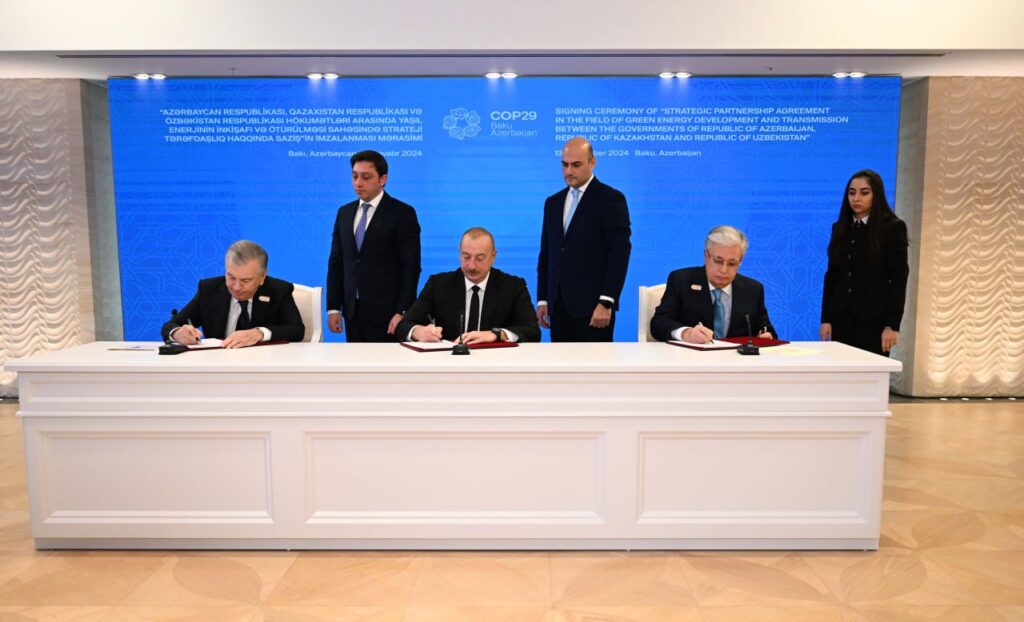
On November 13, on the sidelines of the COP29 summit in Baku, Azerbaijan, Kassym-Jomart Tokayev, Shavkat Mirziyoyev and Ilham Aliyev, the leaders of Kazakhstan, Uzbekistan and Azerbaijan, signed an agreement for a strategic partnership in developing and transporting green energy.

Calling the signing of this agreement a historic event, Aliyev said that “it opens new opportunities for cooperation between the regions of Central Asia and the Caucasus. In fact, the integration processes, the processes related to transportation, energy, and trade between the regions of Central Asia and the Caucasus, allow us to say that these two regions are acting in a synchronized manner in many areas, including in the field of green energy development.”.

The Azeri president added that constructing an electric cable under the Caspian Sea could lead to broader regional collaboration.

Aliyev also highlighted Azerbaijan’s ongoing plans to construct a cable from Azerbaijan along the bottom of the Black Sea to Europe. “The feasibility study for this project is nearing completion, so we will connect Central Asia, the Caucasus, Europe, the Caspian, and the Black Seas with a single energy corridor,” he stated.

In his speech, Tokayev said the trilateral agreement opens new opportunities for integrating the energy systems of Kazakhstan, Uzbekistan, and Azerbaijan, as well as for creating reliable corridors to supply environmentally friendly energy to European and other markets. “Kazakhstan plays an extremely important role here as a large transit territory. The practical results of this Agreement will also contribute to developing the Middle Corridor as a ‘green bridge’ connecting our economies. Close cooperation in this key area will intensify the exchange of experience and advanced technologies between the three states and further strengthen our energy security,” Tokayev said.

Mirziyoyev emphasized the environmental significance of this agreement, noting, “The energy that will be transmitted is wind and solar energy, which will help mitigate the impact on the climate. In this way, we support joint efforts to protect the climate within the framework of the Paris Agreement and achieve the Sustainable Development Goals,” he added.

The three presidents also witnessed the signing of an Executive Program on cooperation in green energy development and transmission by the energy ministers of Azerbaijan, Kazakhstan, Uzbekistan, and Saudi Arabia.

After Long Search, Turkmenistan Finally Finds a New Gas Customer – Iraq

Turkmenistan is reconfiguring its natural gas export options. Despite holding the world’s fourth largest gas reserves, Turkmenistan is exporting less of its gas today than it was 16 years ago.

The big gas pipeline projects conceived nearly 30 years ago – a trans-Afghan pipeline to supply gas to Pakistan and India and a trans-Caspian pipeline to send gas to Europe – remain unfeasible for political reasons.

Russia has been a leading customer for Turkmen gas for most of those three decades, but now Russia is competing for some of the same buyers as Turkmenistan.

Stymied in its search for new markets at seemingly every turn, Turkmenistan is now planning on selling gas to Iraq, via a swap arrangement with Iran that includes bring Iranian companies to Turkmenistan to construct a new pipeline.


Running Out of Options

Turkmenistan is always looking for new gas customers. Iraq was never a potential gas buyer until recently, and in fact, the defunct Nabucco gas pipeline project of some 15 years ago considered Iraq to be a possible supplier of gas for Europe.

Turkmenistan’s deal with Iraq appears to be the only deal possible at the moment, and it is an interesting arrangement.

The two countries are not connected by any pipelines, so Turkmenistan will ship up to 10 bcm of gas to Iran, and Iran will send 10 bcm of its gas to Iraq.

Turkmenistan signed what was described as a “binding agreement” for gas shipments after Iraq agreed to “an advance payment scheme and tax concessions.”

In recent years, about 40% of Iraq’s gas imports came from Iran. After some 20 years of conflict, Iraq’s gas industry is still recovering, and gas imports are needed to operate the country’s power plants. However, sanctions on Iran made it difficult for Iraq to make payments for that gas.


A Rocky Gas History

There are already two gas pipelines connecting Turkmenistan’s gas fields to northern Iran.

At the end of December 1997, the 200-kilometer Korpeje-Kurdkui pipeline with a capacity of some 8 bcm of gas was launched. In January 2010, the Dauletabad-Sarakhs-Khangiran pipeline with a capacity of some 12 bcm started operation.

Turkmenistan was never close to shipping the 20 bcm combined capacity. Exports ranged from 6-8 bcm annually for years.

Iran usually paid for its Turkmen gas in barter, sending a variety of goods, from food to engineering goods and services to Turkmenistan.

In late 2016, a dispute developed between Turkmenistan and Iran over gas. Turkmenistan claimed Iran owed some $2 billion for gas supplies received in the winter of 2007-2008. Iran responded that Turkmenistan was inflating the price.

The winter of 2007-2008 was especially cold causing severe gas shortages in 20 Iranian provinces. One Iranian media outlet reported on December 31, 2016, “Turkmenistan pounced on the occasion to demand a nine-fold hike which yanked the price up to $360 from $40 for every 1,000 cubic meters of gas.”

On January 1, 2017, Turkmenistan halted gas supplies to Iran. The two countries took their cases to international arbitration, which was eventually settled in Turkmenistan’s favor in June 2020.

Since 2017, the two countries have cooperated in a swap agreement with Azerbaijan, but that only called for some 1 bcm of gas.

Turkmen and Iranian officials have been in talks on gas, but after nearly eight years, Turkmen exports to Iran have not resumed.


A Rare Contract

To ship 10 bcm of gas from Turkmenistan to Iran requires maintenance and repair on the two largely dormant pipelines connecting the two countries.

Iranian and Turkmen officials met in early July 2024 to sign a contract for the transfer of gas. That agreement called for “Iranian companies [constructing] a new 125-kilometer gas pipeline along with three gas pressure booster stations in Turkmenistan aimed at boosting annual shipments of gas to Iran to 40 bcm.”

The Iranian companies taking part in the project were not identified, but it is an unusual step for Turkmenistan. The only other foreign company to have a contract to build pipelines on Turkmenistan’s territory was the China National Petroleum Corporation for the three gas pipelines to China (Lines A and B – 15 bcm each, and Line C – 25 bcm).

Increasing shipments to Iran to 40 bcm requires construction of a new pipeline with a capacity of 20 bcm of gas, doubling the current combined capacity of the two existing pipelines.

Reports mentioned that increasing Turkmen gas shipments to Iran was a “long term” goal, but provided no timeframe.

Another matter that is unclear is only 10 bcm of that gas is going to Iraq. There was no information about the final destination of the remaining 30 bcm Iran plans to receive.


Not Much Choice

Turkmenistan has been trying to sell gas to anyone who would be interested. Among the countries Turkmen officials named just this year as potential customers are Azerbaijan, Turkey, Afghanistan, Pakistan, India, Kazakhstan, and vaguely, the European Union.

China is currently Turkmenistan’s main gas customer. Turkmenistan exports about 35 bcm to China via three pipelines with a combined capacity of 55 bcm that also run through Uzbekistan and Kazakhstan.

For nearly 20 years after independence in 1991, Russia was Turkmenistan’s main gas purchaser. Turkmen sold some 45 bcm of gas to Russia in 2008, which represents the zenith of Turkmen gas exports.

Russia drastically scaled back imports of Turkmen gas starting in 2009, and in July 2024 the two countries allowed their biggest contract, for 5.5 bcm, to expire after price negotiations failed.

This was not surprising since Russia has become Turkmenistan’s main competitor for regional customers.

After Russia launched its full-scale war on Ukraine, European countries responded by drastically cutting back on imports of Russian gas. Russia turned to Asian markets and signed deals to supply gas to Turkmenistan’s neighbors Kazakhstan and Uzbekistan.

Worse, after several straight winters of power shortages, Kazakhstan and Uzbekistan are reorienting their gas production for domestic use. Each country has the right to pump up to 10 bcm of its own gas into the pipelines that cross through their territories running from Turkmenistan to China.

Since neither country is currently in a position to export its full allotment, Russia has a deal to take the spare capacity and ship its gas to China via the Turkmenistan-China pipelines, despite Turkmenistan having sufficient gas to replace Kazakhstan and Uzbekistan’s share of pipeline space.

Gas exports to Afghanistan remain improbable due to a lack of foreign investors. Turkey and Azerbaijan are enthusiastic about helping transit Turkmen gas to Europe, but the infrastructure still does not exist to accomplish this.

The 40 bcm referred to in reports about the recent Iran-Turkmen agreement could indicate Iran will be purchasing Turkmen gas again in the future, and in larger quantities than previously.

For now, however, the surest deal Turkmenistan is able to find to increase its gas exports is the agreement with Iraq. Whether this swap arrangement involving Iran can deliver the promised 10 bcm remains to be seen.

Kyrgyzstan Secures Pavilion in Uzbek-Afghan Border Trade Center

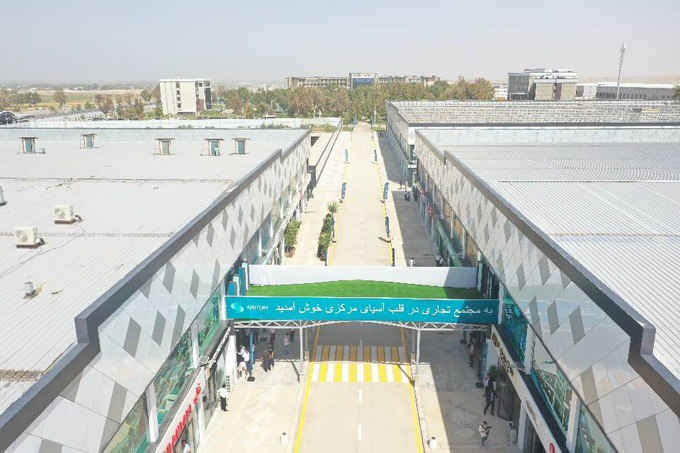
The Ministry of Economy and Commerce of Kyrgyzstan has acquired a trade pavilion at the Termez International Trade Center in the town of Termez, Uzbekistan, near the Afghan border. This purchase agreement was signed on November 11 between the ministry and LLC Termez International Trade Centre, the center’s management company.

This pavilion offers Kyrgyzstan a strategic foothold to expand its presence in the markets of Uzbekistan and Afghanistan, promoting the export of Kyrgyz agricultural and industrial goods while enabling direct interaction with Afghan business partners. The Kyrgyz government has expressed an ongoing interest in strengthening economic relations with Afghanistan. From January to August 2024, trade between the two countries reached $14 million, with Afghan exports to Kyrgyzstan accounting for $6 million of this total, as noted in a recent report.

The Termez International Trade Center serves as a vital hub at the intersection of Central Asian trade routes, facilitating substantial trade flows between Uzbekistan and Afghanistan. Opened on August 29 by Uzbek Prime Minister Abdulla Aripov and the acting Afghan Deputy Prime Minister Abdul Ghani Baradar, the center features retail spaces, hotels, a medical center, and other amenities. It also supports transactions in multiple currencies, including U.S. dollars, euros, rubles, and yuan.

Notably, Afghan citizens are allowed to visit and conduct trade at the Termez center for up to 15 days without requiring an Uzbek visa, enhancing accessibility for Afghan traders.

Asia Now Creating a Market for Central Asian Art in Paris

When we think about spreading knowledge of Central Asian art in Europe, we might think of exhibitions, of festivals, of panels and talks, not necessarily of an art fair. However, in the contemporary art world, it is today the market, more than art critics, which dictates the emergence of certain art scenes as a whole.

For the historically underrepresented Central Asian art market, smaller fairs represent today an important alley, more than the big fairs such as Art Basel – which just had its second Paris iteration this October. Smaller “boutique fairs,” as they are called, often present curated programming which allow a wide public – not just collectors and buyers – to enjoy the art as it was an exhibition. A selling one, of course. 

In Paris, the most relevant fair which has historically presented Central Asian artists to the European public is called Asia Now, and it took place in Paris from October 17 to 20. Entirely dedicated to Asian art, the fair has historically tried to fill the gap for Central Asian art in the European market in the past ten years of its existence.

The fair has selected more than 70 leading and emerging contemporary art galleries from all over the world, presenting more than 220 artists coming from 26 territories from all over Asia and its diaspora, stretching from Central Asia to the Asia-Pacific, including West, South, South-East, and East Asia.

Their commitment to expanding knowledge of Central Asian art in Europe culminated last year in a show which was indeed focused on Central Asia, and curated by the artist group Slav and Tatars.

While seminal Central Asian galleries such as the Aspan Gallery from Almaty and Pygmalion Gallery from Astana didn’t return to Asia Now this year, the fair still presented a number of Central Asian artists and practices, interspersed between the main show, and the booths. 


Central Asian Artists in the Radicant’s Main Show

The main exhibition of Asia Now was curated by Radicants, a collective founded by art critic Nicolas Bourriaud, and it was centered on sacred ceremonies seen as a powerful tool for re-examining societal structures and reconnecting with ancestral roots.

Called “Ceremony,” the main show was co-curated by Nicolas Bourriaud and Alexander Burenkov, a curator of Russian origins who has been working for a long time with Central Asian narratives, which are also featured prominently in the show.
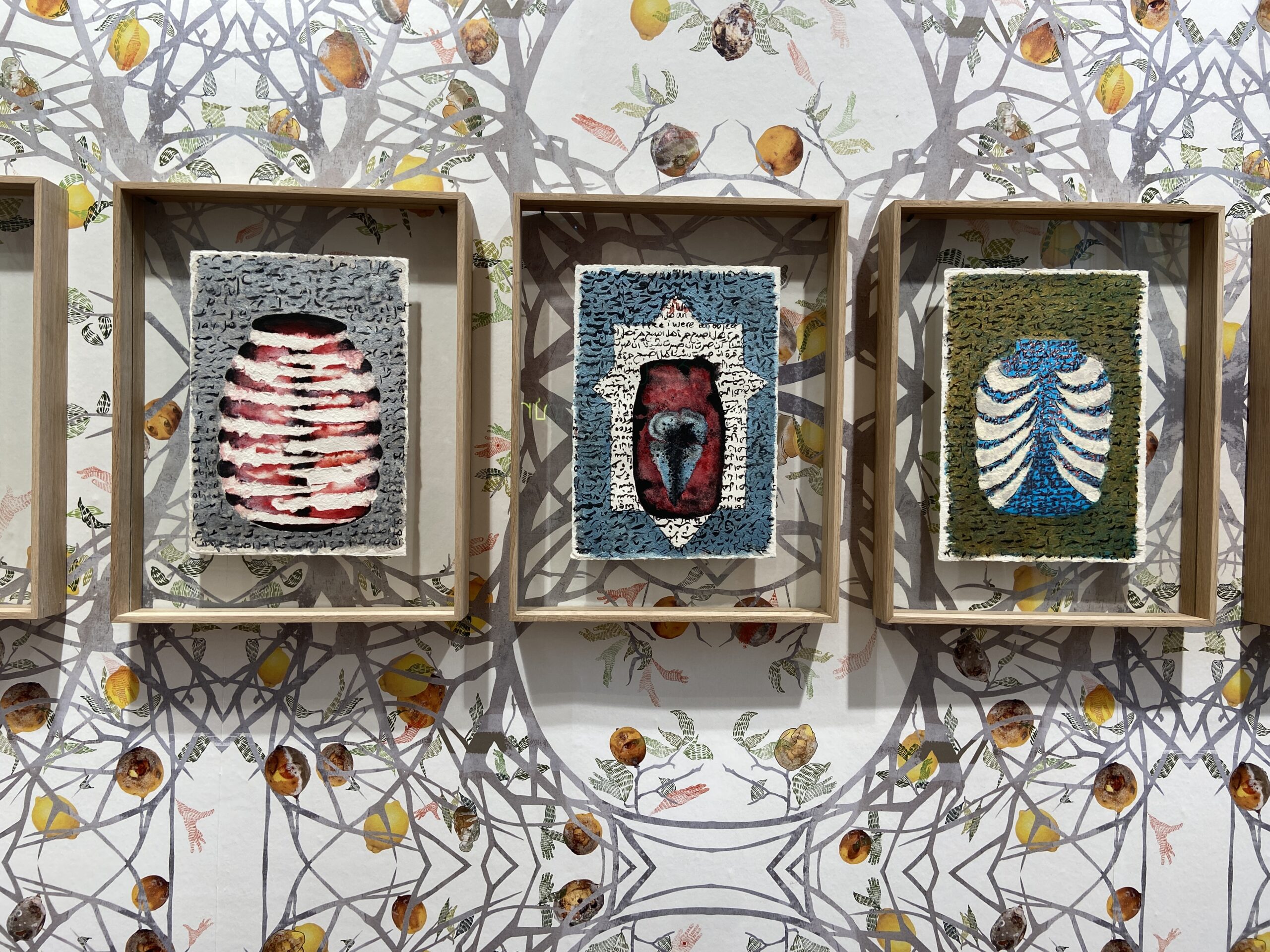
Image: TCA, Naima Morelli

The idea of ceremony ties to the tenth anniversary of the art fair, but at the same time the curators opted to explore the nuances of ritual as both a “celebration of ancestral wisdom” and a “critical tool for interrogating and redefining established traditions and power dynamics.”

As Burenkov noted, the decision to use the theme of ceremony emerged after conversations with Asia Now director Alexandra Fain. “The choice fell on ‘ceremony’ in all its variability and polysemy [was used] to explore the non-obvious meanings of ritual through the eyes of contemporary artists as well as philosophy, science, and poetry which inspire them,” Burenkov stated.

In selecting the 18 artists for the exhibition, Bourriaud and Burenkov brought together both well-known and emerging figures. Their aim was to “put together established and well-known artists with artists completely unknown to the French art scene.” This fusion underscored the show’s mission to amplify often overlooked voices from Asia and Central Asia and to offer new perspectives to a European audience. Through these artists, the curators sought to dispel a simplistic, almost consumeristic notions of celebration, presenting instead an exploration of how rituals shape and transform cultural identity.


Ariuna Bulutova’s Shamanic Rituals

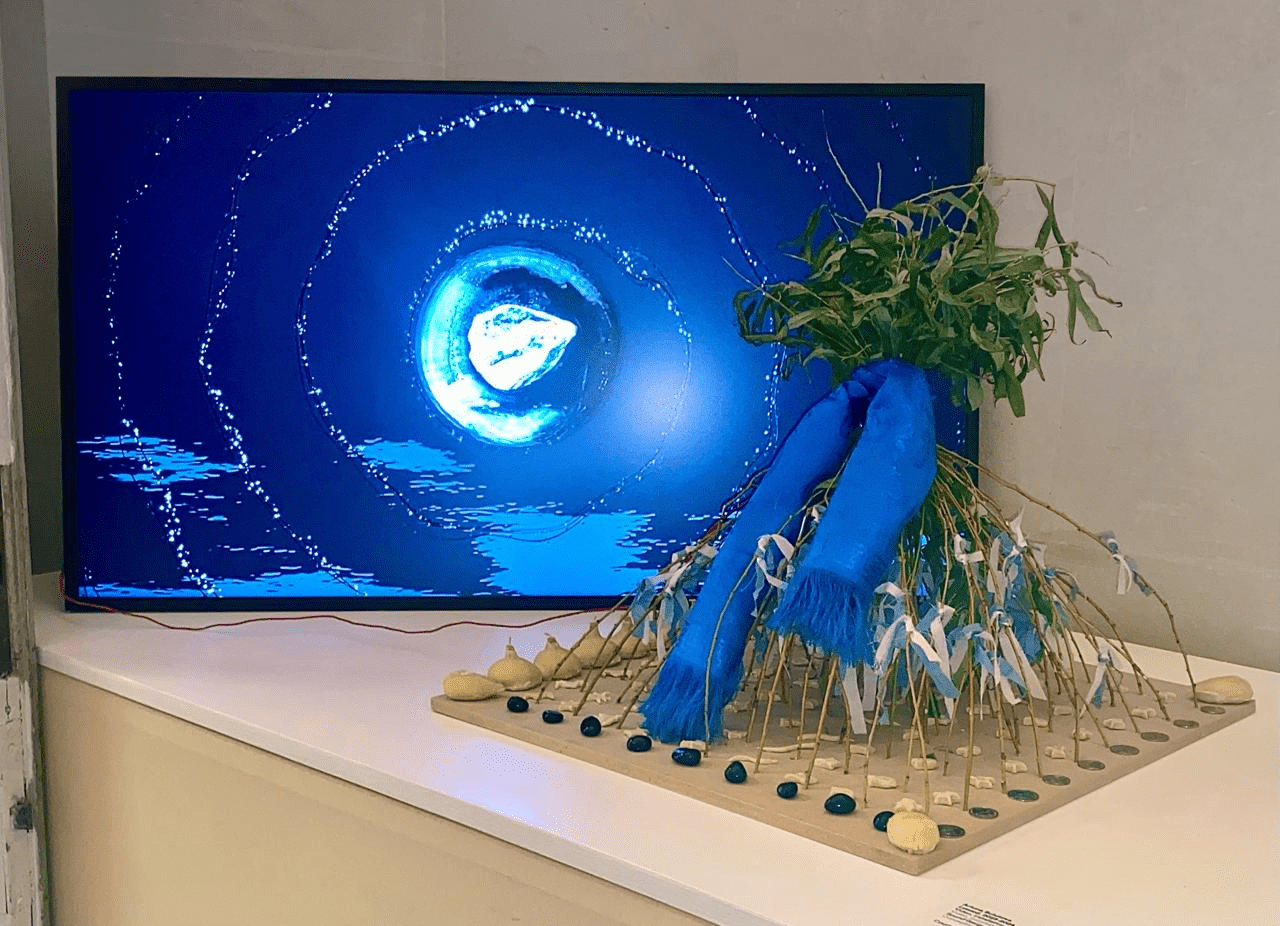
One of the show’s most impactful Central Asian voices is Ariuna Bulutova, a Buryat artist who draws from indigenous practices to explore human relationships with the natural world.
Installation by Ariuna Bulutova; image: TCA, Naima Morelli

“Bulutova’s work is deeply rooted in ‘Lusuud,’ a Buryat shamanic ritual, which she integrates into a video installation guided by her parents, who are practicing shamans,” explained the curator. Bulutova’s art interweaves ancestral knowledge with climate awareness, creating a platform where traditional Indigenous wisdom connects with modern ecological issues. Her work serves as an urgent call for renewed respect for the environment, a quest to heal our relationship with the world beyond the human.

Presenting the show at La Monnaie was challenging, yet inspired the selection of participatory works. “Since the building is a historical monument, nothing can be attached to the walls,” Burenkov noted, explaining the need to create a unique setup that prioritized performative pieces. 

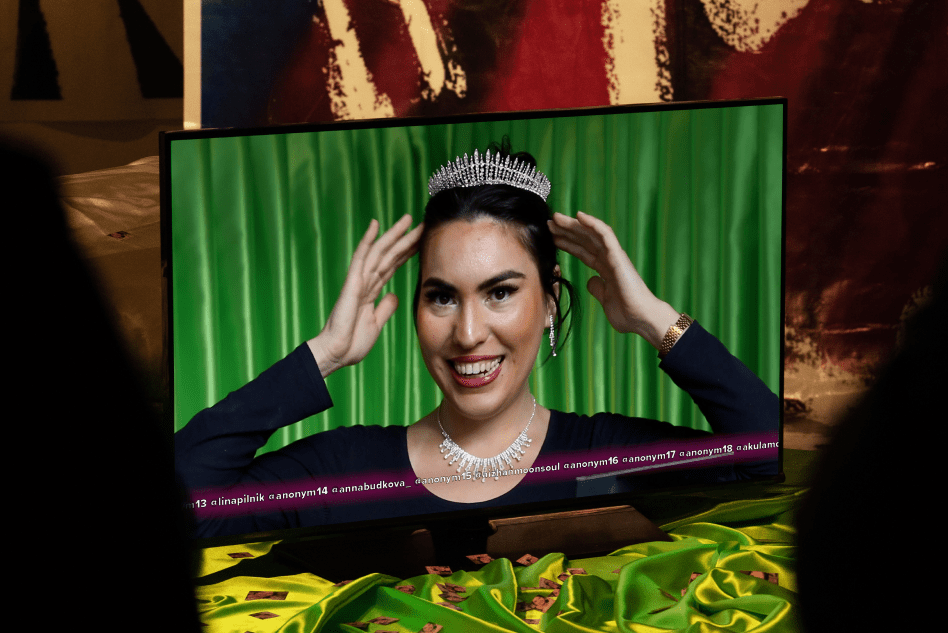
Another Central Asian artist in the show, who presented a striking video piece called “Don’t Miss the POV”, was Uzbek artist Faina Yunusova. Living between Uzbekistan and Germany, Yunusova navigates the complexities of her cultural background, seeking to create artistic representations that resonate with depth and authenticity, while embracing the fluidity of contemporary existence.

In her artistic practice, Yunusova focuses on self-reflection and societal inquiry, exploring themes of memory and communal expectations in the digital age. She is also engaged in postcolonial studies within Central Asia, with a focus on the hybridity and fluidity of cultural identity and self-exoticization. Her expansive portfolio spans monumental painting, photography, video, digital art, artificial intelligence, performance, and installations.

While curating a ritual-focused show within a commercial fair context might be challenging, Burenkov saw it as an opportunity to disrupt market-driven expectations. Performances like Darius Dolatyari-Dolatdoust’s “Flags Parade” invited visitors to engage with questions of identity and belonging, questioning “whether we are local or migrant, European or Asian.” The artist’s work, which involved costumes symbolizing a blend of Iranian, French, Polish, and German heritage, “queers the traditional model of the art fair” and promotes unexpected, transformative encounters.

Reflecting on the role of art fairs as rituals, Burenkov likened curating to “cooking out the show”— a process with its own rhythm and traditions that requires both careful planning and improvisation. 


Gulnur Mukazhanova’s Explorations of Kazakh Craft

Walking between the different booths of the fair, one of the most fascinating installations that jumps out was the work of Gulnur Mukazhanova in the booth of Michael Janssen.

One of the most interesting names on the scene, Mukazhanova’s canvases – made of felt, a material carrying a strong significance – engage deeply with Kazakh cultural heritage and the complexities of post-Soviet identity. 
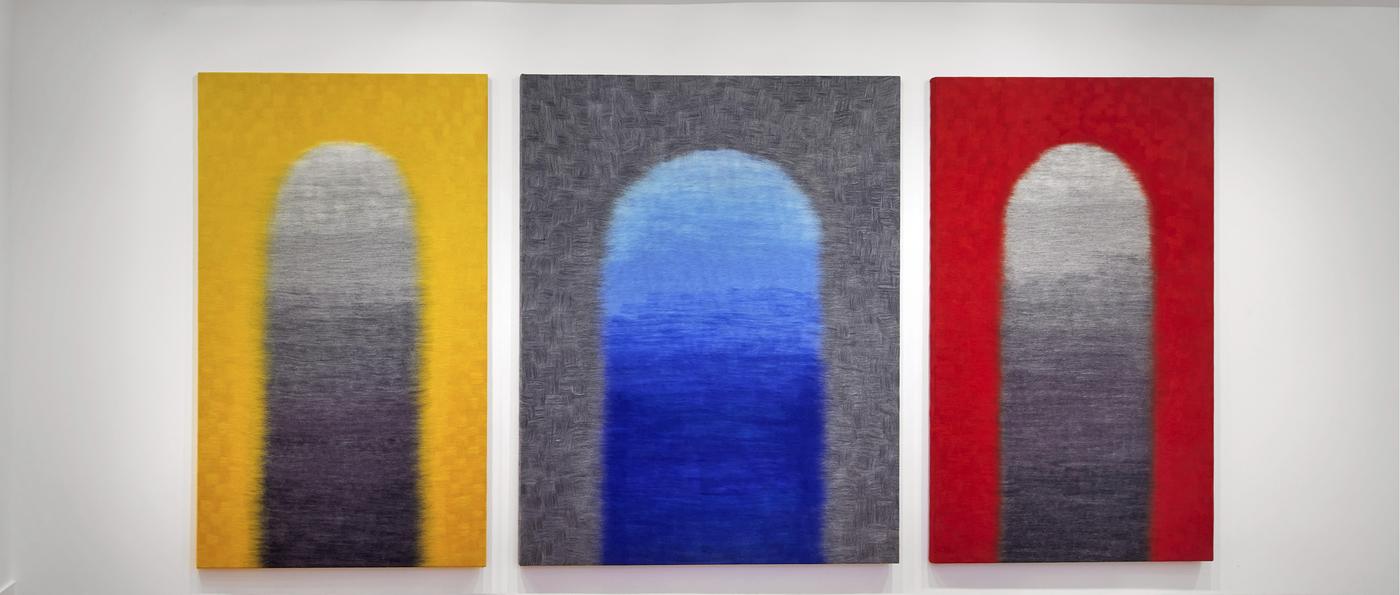
Artwork by Gulnur Mukazhanova; image: TCA, Naima Morelli

While presented in a commercial context, these works are highly touching and aesthetic encounters, and present a depth which situate them not just as objects for sale, but also meaningful explorations of themes such as nationalism, gender, and inherited trauma.

The artist is employing the traditional Kazakh medium of felt in new and powerful ways. While felt historically holds a central role in Kazakh craft as a material for everyday life, Mukazhanova transforms it into symbolic canvasses through which she addresses hidden wounds and the unconscious impacts of cultural expectations.

This series, shaped by Mukazhanova’s reflections on the societal pressures faced by women in Central Asia, examine how gender expectations are perpetuated and internalized over generations. She describes her use of felt as an abstract, textured language for unpacking complex histories and norms that shape identity. 


Nika Project Space Gallery Dedication to Central Asian Voices

Besides the main show and singular powerful pieces such as Mukazhanova’s, attention to Central Asian narratives was shared by a number of galleries in the stands. Among these, one of the most interesting was certainly the Dubai and Paris-based Nika Project Space. 

While the Nika booth at Asia Now was entirely dedicated to Palestinian artist Mirna Bamieh, the gallerist Veronika Berezina has a deep commitment to showcasing the work of artists with roots in Central Asia. 
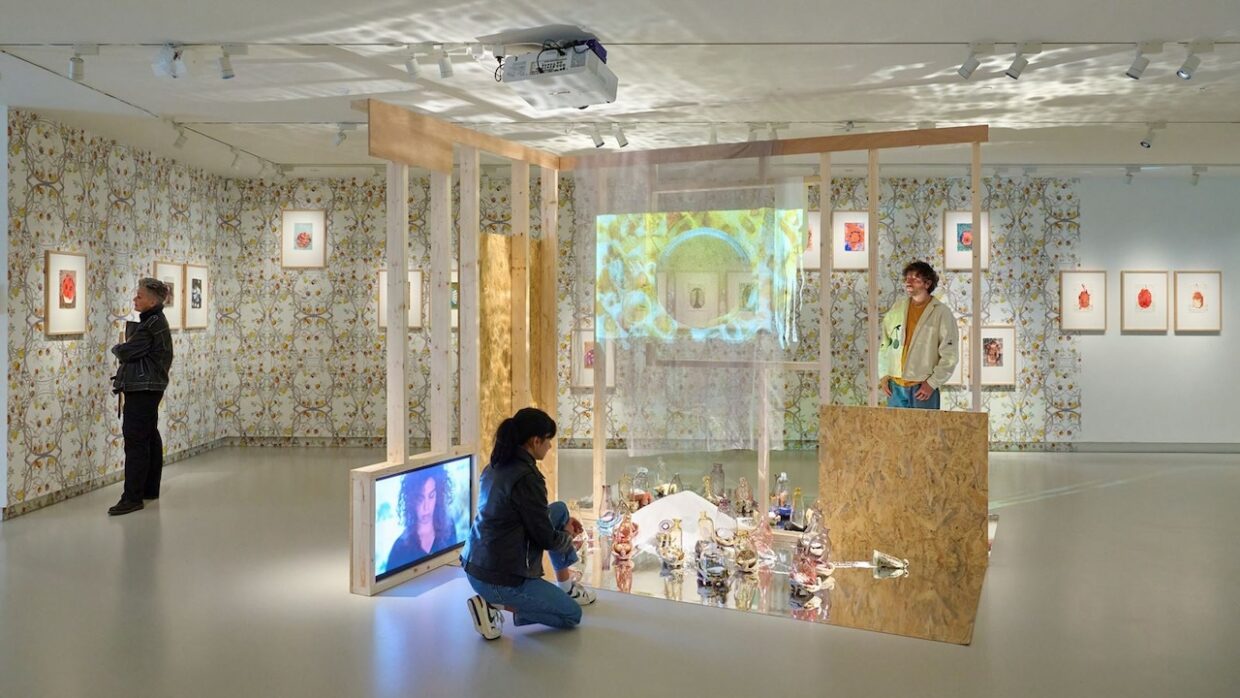
Nika Project Space; image: TCA, Naima Morelli

“Many of the artists we work with have roots in Central Asia, whether they were born there or are part of the region’s vast diaspora,” says Berezina. One such artist is Alexander Ugay, a Kazakh-Korean photographer and videographer whose work explores the experiences of Central Asian immigrants. 

Ugay is the creator of “cinema-objects” within the experimental collective Bronepoezd, which means “armed train” in Kazakh, of which he is one of the founders alongside Roman Maskalev. One of the most active figures in the Kazakh art scene, Ugay was educated at St. Petersburg University and Bishkek University in Kyrgyzstan.

Ugay’s video piece, “100,000 Times,” was featured in a group show at Nika Gallery last year. The work represents a group of Korean migrant workers from post-Soviet countries, with the single, displaced laborer, subject to the brutality of industry, seen as representing and reimagining the dissolution of an exploited community. In another piece, “Elsewhere in Unknown Return”, Ugay uses AI to re-visualize this community in archival form, centered around the 1937 Korean deportation, where multiple architectures of a mass exodus are created and algorithmic inputs adapted to produce accurate results.

As Berezina describes it, “Alexander’s work is deeply rooted in the lived experiences of Central Asians. He himself is part of the third generation of Koreans who were displaced to Kazakhstan during the Stalin era, and that sense of cultural dislocation and the search for identity is palpable in his art.” 

Berezina’s own background as a Russian-born art patron has shaped Nika Gallery’s curatorial vision; “I was always drawn to art, even during my studies in international law,” she says. “When I decided to create my own gallery, it was important to me to focus on artists and practices that are often underrepresented on the global stage.”

By fostering these kinds of deep collaborative relationships with artists, Nika Gallery has established itself as a hub for cultural exchange and cross-pollination. Besides their presence at Asia Now, the gallery’s recent expansion to Paris further solidifies its role as a bridge between the art scenes of the Middle East, Central Asia, and Europe, offering audiences a chance to engage with Central Asian creativity.

As galleries, artists and curators continues to grow their practices and lines of research, it’s heartening to see an increasing number of new nuanced narratives from the Central Asian region coming to the forefront of the European art scene, and somehow becoming more and more relevant in times of “third cultures,” migrations, diasporas, and digital nomadism. 

“Our goal is not just to showcase the work of these artists, but to create a space for dialogue and understanding,” Berezina says. “Central Asia is a region that is often misunderstood or overlooked, and we believe that art has the power to change that narrative, to bring people together, and to celebrate the diversity of human experience.”

This idea is also shared by Asia Now’s founder Alexandra Fain who, with this latest edition of the fair, proved that the Parisian event has remained steadfast in their commitment to amplifying Central Asian voices.