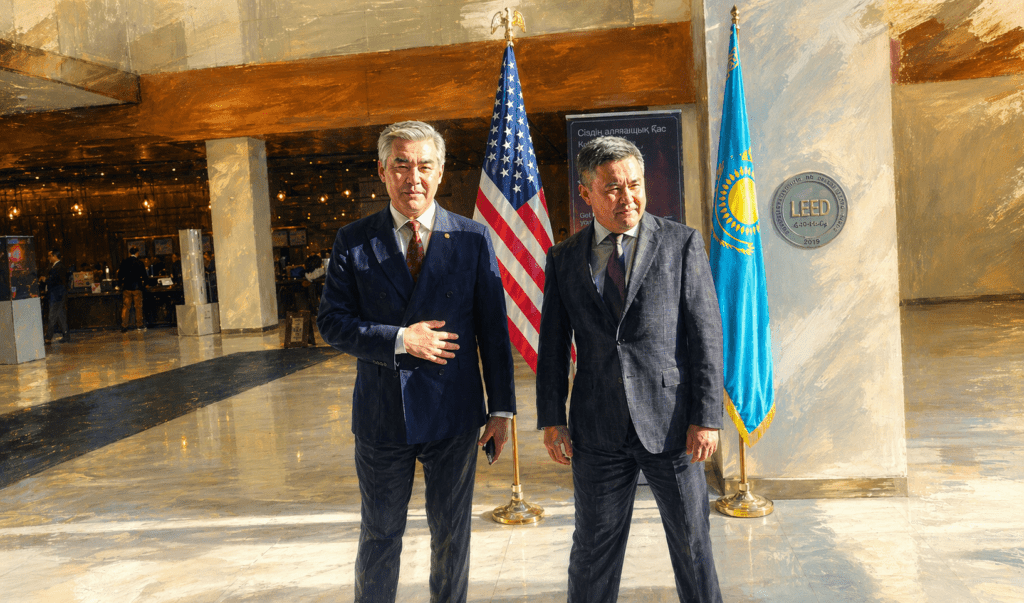
Kazakhstan Finance Day in New York Showcases Market Reform, IPO Ambitions, and Alatau City Pitch
-
By
 K Krombie
At Kazakhstan Finance Day in New York, officials and executives used the panel “Investment Opportunities in Kazakhstan” to present the country as entering a new phase of market development, citing macroeconomic stability, capital-market reform, potential initial and secondary public offerings, and infrastructure tied to the Alatau City project.
The panel session was held at Citigroup headquarters in Manhattan and was moderated by Stephanie von Friedeburg, global head of Citi’s Public Sector Group. Speakers included Timur Suleimenov, governor of the National Bank of Kazakhstan; Adil Mukhamejanov, chairperson of the management board of the Kazakhstan Stock Exchange (KASE); Zhandos Shaikhy, deputy chairman of the management board of Baiterek National Managing Holding; Aidar Ryskulov, managing director for economics and finance at Samruk-Kazyna; and Bayan Konirbayev, deputy CEO and chief digital officer of the Alatau City Authority.
Opening the event, von Friedeburg noted that the forum’s return to Citigroup headquarters for a third time reflected the continued engagement between Kazakhstan and U.S. investors. Kazakhstan’s ambassador to the United States, Magzhan Ilyassov, linked the event to growth in bilateral economic ties, citing more than $17 billion in commercial agreements signed during President Kassym-Jomart Tokayev’s November 2025 visit to Washington, and adding that further agreements were under consideration.
The first financial presentation came from Suleimenov, who reported that Kazakhstan’s economy grew 6.5% in 2025, inflation had eased to 11%, and the National Bank remained committed to returning inflation to its 5% target. He framed the country’s investment case around tighter macroeconomic coordination, fiscal discipline, and financial-sector development.
“We’re also exploring the development of a national crypto reserve framework, where digital assets will gradually be accumulated and managed as part of a sovereign reserve diversification strategy,” Suleimenov explained. He also pointed to continued work on the digital tenge and national digital financial infrastructure.
Suleimenov connected that financial agenda to the investment case, arguing that Kazakhstan was reducing its structural dependence on oil revenue and moving ahead with legal and tax changes aimed at improving the investment climate. He described the Middle Corridor as increasingly important and called the route through Kazakhstan, the Caspian, and the Caucasus “the only viable, reliable route” between the East and West.

Kazakhstan Finance Day in New York; image: K. Krombie
The discussion then moved to Samruk-Kazyna’s finances and privatization plans. Aidar Ryskulov put the fund’s assets under management at $88 billion and EBITDA at $10.8 billion. He indicated that the fund intended to remain active in international debt markets this year.
Ryskulov stated that Samruk-Kazyna was targeting a public-market transaction this year, with London, Hong Kong, and Astana under consideration, although timing would depend on macroeconomic conditions. He later pointed to IPO plans for the national railway company, Kazakhstan Temir Zholy (KTZ). “Our capacity is roughly 55 million tons, and we’re going to double this capacity in five to seven years,” he said.
Ryskulov also characterized Kazatomprom as “one of the best assets” and presented it as undervalued and a high-dividend company.
Zhandos Shaikhy focused on Baiterek’s scale and project pipeline. “Today, we manage over $36 billion of assets across diversified sectors,” he remarked, adding that “during the last year, Baiterek has extended more than $20 billion of financing support” to Kazakhstan’s economy through lending, leasing, guarantees, insurance, and equity participation. He added that the holding was “currently advancing a list of 28 national scale projects” in sectors including energy, mining, petrochemicals, logistics, data centers, and rare earth minerals.
Adil Mukhamejanov presented Kazakhstan’s capital market as larger and more liquid than many foreign investors assume, putting equity market capitalization at $96 billion, corporate bonds at $25 billion, and government securities outstanding at about $63 billion. He put average daily volume at around $150 million, average daily transactions at about 14,000, and cited the rise in brokerage accounts from 230,000 in 2021 as a sign that more households were entering the market.
Mukhamejanov outlined the reform agenda being prepared with the regulator and the National Bank, including a capital-market development program and a new law on the securities market. The measures he listed included pension reforms to ease transfers from the Unified National Pension Fund to private asset managers, and a simpler digital ID system for non-residents. He also pointed to continued work on links with Clearstream and other international market infrastructure.
On digital assets, Mukhamejanov described KASE as working on two approaches: converting existing instruments into digital form, and issuing new obligations directly in digital form. He said the aim was to build “a bridge between traditional capital markets and blockchain-based instruments” and make issuance more efficient.
The final presentation turned to urban development, with Bayan Konirbayev presenting Alatau City as a project near Almaty centered on logistics and the digital economy. He projected that the city would grow from about 50,000 residents to 1.8 million by 2050.
He also addressed the project’s legal and financing model. “We are going to have a new legal framework,” he said, before outlining what he called a shift toward a “tokenized economy.” Konirbayev added that it would operate as a system in which assets and investment instruments would be tokenized and governed under new rules, supported by public-private partnership structures, national-currency and fintech solutions, and a “digital twin” intended to improve transparency and help track tokenized transactions.
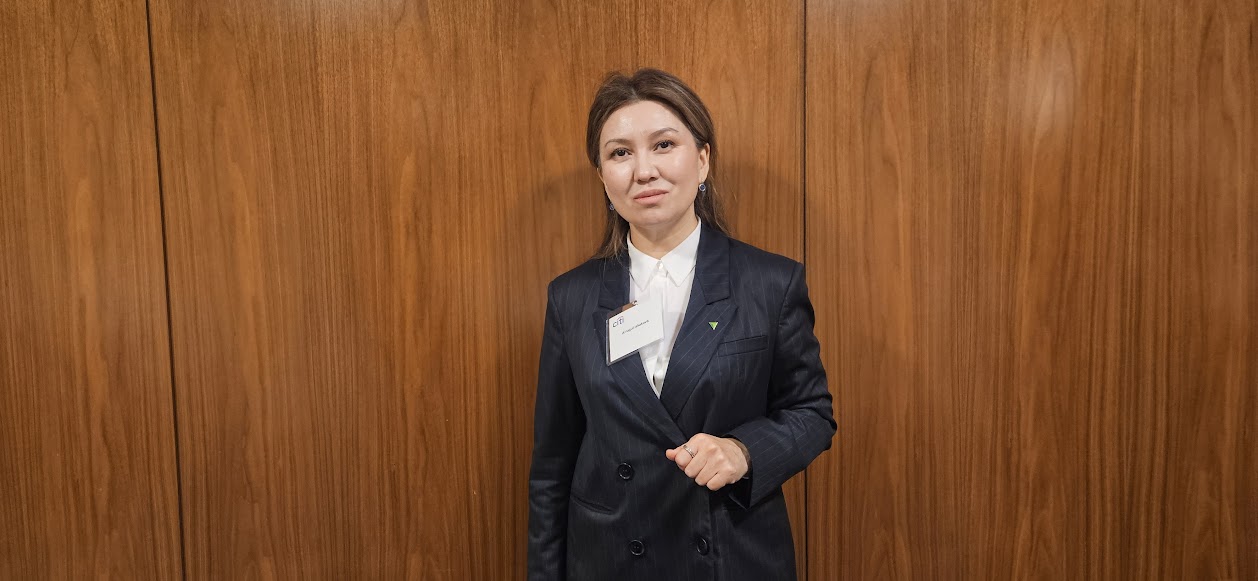
Ainagul Iskakova, deputy CEO of KASE at Kazakhstan Finance Day in New York; image: K. Krombie
Among those in attendance was Ainagul Iskakova, deputy CEO of KASE, who observed that the session’s value lay in hearing direct investor reactions. “The most crucial point for me is to hear the feedback. Because when something goes well, it’s not interesting. When something goes wrong, it is where I understand that there is room to grow.”