Singer, poet, and lyricist MEREY is among a younger group of artists bringing a different sensibility to music in Kazakhstan. Her work is rooted in Kazakh-language expression, but it also pushes beyond familiar expectations of how a female singer should sound and present herself.
In an interview with The Times of Central Asia, MEREY discusses the influence of poetry on her lyrics, the reaction to experimentation, and what she believes is missing from Kazakhstan’s contemporary music scene.
TCA: Tell us a little about yourself. How did you get into music?
MEREY: I came to music at 17, that’s when I wrote my first song in English. Before that, for as long as I can remember, I had been writing poetry; it was my first form of self-expression.
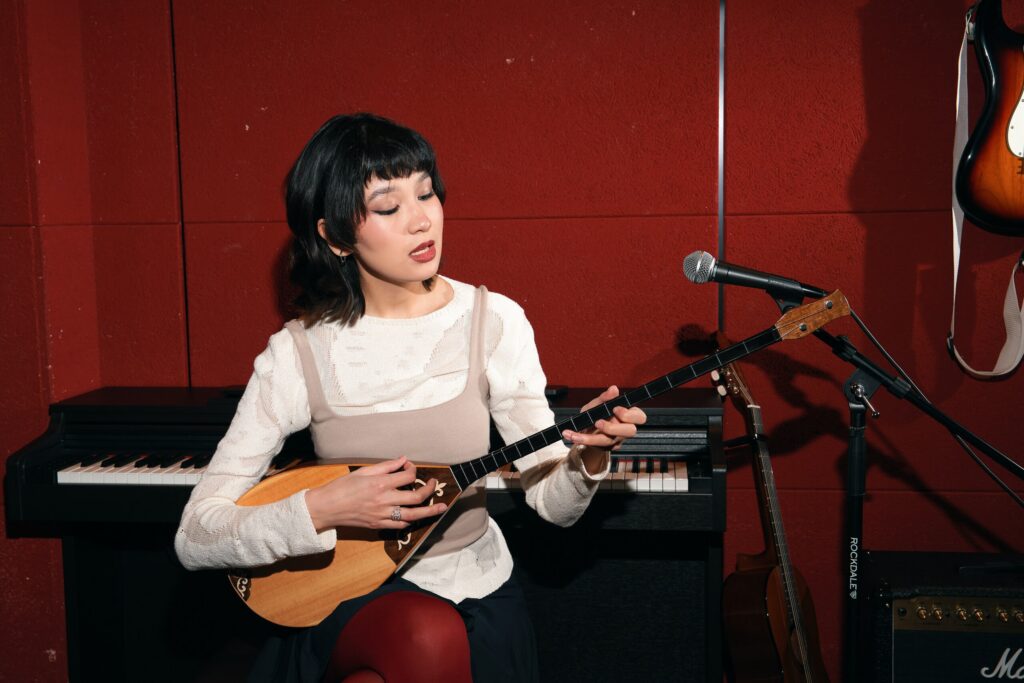
During my school years, I also studied music more formally. I played in a national orchestra, where I both sang and performed dombra parts. That experience strongly shaped my sense of stage presence and musical language.
Today, I position myself as a poet, singer, and lyricist. For me, text and music are inseparable.
TCA: Who or what influenced your artistic development the most?
MEREY: Since school, I have read the works of Mukaghali Makatayev, a classic of Kazakh poetry known for lyrical verses about love, homeland, and the human experience, and Fariza Ongarsynova, a prominent poet who wrote about emotions, time, and women’s lives. They left a deep mark on me as a poet, and echoes of their style can be found in my lyrics.
As a teenager, I listened to Billie Eilish, Lana Del Rey, and The Neighbourhood. Later, Mitski, Zemfira, Valentin Strykalo, and Børns. Now I feel close to what Chappell Roan and Meg Myers are doing. My taste leans toward alternative music with an emphasis on vocals, lyrics, and guitar riffs, with a slightly detached aesthetic. This directly informs my own music.
TCA: Your music is often described as a blend of traditional elements and modern electronics. How did this sound take shape?
MEREY: I wouldn’t fully agree with the phrasing about electronics, but my sound is in many ways inspired by Darkhan Juzz. He was the first artist from Kazakhstan who truly impressed me with his sound.
I come from a Kazakh-speaking background, so my lyrics tend to be more literary rather than conversational, unlike many artists of the new school. That’s thanks to my parents and my education in a Kazakh-language school.
The modern side comes from my musical tastes, especially the Western scene. My sound combines a Western sensibility with precise, expressive Kazakh language. It’s a mix of Western thinking and Kazakh tradition and that is exactly what resonates with listeners.
TCA: How important is it for you to preserve cultural roots in contemporary music?
MEREY: It is fundamentally important. As I grow older, I become more conscious, and even stricter, about the Kazakh language and tradition. I’m glad that today national elements, ornaments, traditional clothing, interest in Tengriism, and the language itself, are once again becoming part of the cultural conversation among young people.
My goal is to promote proper, expressive Kazakh in music. I consciously use idioms, proverbs, and older speech structures that are gradually disappearing from everyday language. For me, it’s important that the language of my songs remains pure and precise, even if in everyday life I allow myself more freedom.
TCA: Do you feel that music can help reinterpret tradition?
MEREY: Absolutely. Music is a universal language that works on an emotional level, even if the listener does not understand the words.
My music is not strictly traditional, but it is precisely through such hybrid forms that listeners from other countries become interested in our culture. People often write to me asking for translations of my lyrics into English, Turkish, and other languages, they want to understand what I’m singing about.
Tradition is not a fixed concept. It is constantly evolving. It is entirely possible that in 20 years, the music of my generation will also be perceived as part of tradition. It is thanks to new-wave artists, including me, that young people are discovering Kazakh culture in a new context.
TCA: Which traditional Kazakh instruments or musical motifs inspire you the most?
MEREY: I am an improvisational dombra player, and the dombra was my first instrument. My musical ability was noticed at school, after which I studied in an orchestra for gifted children, where we combined vocals and instrumental performance. I still have my first dombra, which is now more than 12 years old. That’s where everything began.
Although I’ve lost some of my former skill, I still regularly listen to küy and terme, they continue to inspire me. I also feel close to instruments such as the zhetygen, shankobyz, and kobyz. Although I don’t play them, I closely follow how they are used in contemporary music. For example, I really connect with how the kobyz is integrated into modern genres whether pop, R&B, or electronic music.
In the future, I want to carefully incorporate traditional instruments into my work. For now, it is technically difficult. There are almost no high-quality plugins for Kazakh instruments in digital production software, so everything has to be recorded live.
For example, in my song Nege Bilmedim? I had planned to use the kobyz to create an anxious atmosphere, but in the end I replaced it with a violin for that reason. I especially liked how the kobyz was integrated into contemporary electronic music in the song Jiber, featured on OYU. This track is performed by my close friend Mira.
I would also mention songs by Yerbolat Qudaibergenov, Lyazzat Alauy and Men Qazaqpyn, where contemporary sound is subtly intertwined with traditional dombra motifs. More recently, there is the track Aitshy, where M’Dee combines kobyz with R&B, creating an interesting and fresh sound.
TCA: Some people are quite sensitive to experiments with traditional music. Have you encountered that kind of reaction from audiences?
MEREY: Yes, quite often. The Kazakh cultural space is generally sensitive to newness and I love experimenting. My song Carpe Diem, where I touch on female sexuality in the Kazakh language, caused a strong reaction. More recently, a live performance of my song Betperde went viral on TikTok, where I experimented with vocal delivery and that triggered a wave of criticism.
People need time to adjust to new things. At the same time, if you look at the Western scene, experimentation with form and presentation is seen as an essential part of artistic expression. For example, Mitski uses the microphone as an expressive, sometimes provocative stage object; Chappell Roan works with visual imagery, including deliberately exaggerated elements; Lana Del Rey turns the stage into a cinematic space; Fergie adds strong physical expressiveness and elements of performance. Western audiences have largely moved beyond expecting “just beautiful singing.” Today, listeners care not only about how an artist sings, but what they communicate through performance, image, and concept.
There is still a fixed idea of what a Kazakh female singer is “supposed” to look like: long hair, restrained style, long dresses, traditional aesthetics. When an artist presents a different visual language, it can create dissonance. I believe the development of a music scene is impossible without experimentation. Artists must stop being afraid, and listeners must learn to accept the new. Kazakhstan’s music scene still has significant room for growth. That growth begins when artists stop fearing experimentation and audiences become more open to innovation.
TCA: How do you assess the development of Kazakhstan’s contemporary music scene?
MEREY: Honestly, as an artist, I often feel disappointed. There is a lack of new names, fresh sound, and bold decisions. Much of it feels repetitive, almost formulaic. At the same time, I recognize that as a listener I might perceive it differently.
TCA: In your view, what can make music from Kazakhstan interesting to a global audience?
MEREY: First of all, language and culture. We have a very rich cultural heritage, and when it is combined with modern genres, it becomes accessible and compelling to the world. When nomadic aesthetics meet contemporary sound, a unique artistic product emerges. That is where our potential for global dialogue lies.
For example, Yenlik, who recently performed on COLORS. By Kazakh standards, she appears quite traditional: long hair, restrained style, Kazakh-language lyrics, and elements of national aesthetics. At the same time, there is a distinctly Western confidence in her delivery, which makes her relatable to international audiences. If she worked exclusively within traditional forms such as throat singing, it would likely remain more local in appeal. But by combining Kazakh elements with rap, she becomes accessible to a broader audience.
TCA: In what direction would you like to develop your sound further?
MEREY: I feel that I’ve outgrown my melancholic indie aesthetic and want to move forward. I’m interested in experimenting with vocals and production, particularly electronic pop, UK drill, techno, and more dance-oriented music. Right now, I’m in a phase of searching for and shaping a new sound.
TCA: What are you working on now, and what can listeners expect soon?
MEREY: I’m preparing for my first tour across Kazakhstan, with concerts in Almaty, Astana, and Shymkent. It will be a large-scale program, almost two and a half hours long, featuring material from my solo album HIGANBANA, as well as guest artists in each city. There will also be merchandise, meet-and-greets, and audience interaction. For me, this is an important and exciting stage.
At the same time, I’m working on my first poetry collection in three languages. Over the years, I’ve accumulated enough material.
TCA: How do you see your art in a few years?
MEREY: For me, creativity is not only music, it also includes poetry, producing, and working with young artists. In the future, I’m also interested in film. More specifically, in three years I see myself as one of Kazakhstan’s leading artists, with a strong audience and the ability to perform on major stages both at home and abroad. It is important for me not only to grow personally, but also to support the next generation of artists. And through all of this, to preserve what matters most: freedom, youth, and a sincere love for what I do.