• KGS/USD = 0.01144 0%
  • KZT/USD = 0.00213 0%
  • TJS/USD = 0.10456 0.19%
  • UZS/USD = 0.00008 0%
  • TMT/USD = 0.28490 0%
  • KGS/USD = 0.01144 0%
  • KZT/USD = 0.00213 0%
  • TJS/USD = 0.10456 0.19%
  • UZS/USD = 0.00008 0%
  • TMT/USD = 0.28490 0%
  • KGS/USD = 0.01144 0%
  • KZT/USD = 0.00213 0%
  • TJS/USD = 0.10456 0.19%
  • UZS/USD = 0.00008 0%
  • TMT/USD = 0.28490 0%
  • KGS/USD = 0.01144 0%
  • KZT/USD = 0.00213 0%
  • TJS/USD = 0.10456 0.19%
  • UZS/USD = 0.00008 0%
  • TMT/USD = 0.28490 0%
  • KGS/USD = 0.01144 0%
  • KZT/USD = 0.00213 0%
  • TJS/USD = 0.10456 0.19%
  • UZS/USD = 0.00008 0%
  • TMT/USD = 0.28490 0%
  • KGS/USD = 0.01144 0%
  • KZT/USD = 0.00213 0%
  • TJS/USD = 0.10456 0.19%
  • UZS/USD = 0.00008 0%
  • TMT/USD = 0.28490 0%
  • KGS/USD = 0.01144 0%
  • KZT/USD = 0.00213 0%
  • TJS/USD = 0.10456 0.19%
  • UZS/USD = 0.00008 0%
  • TMT/USD = 0.28490 0%
  • KGS/USD = 0.01144 0%
  • KZT/USD = 0.00213 0%
  • TJS/USD = 0.10456 0.19%
  • UZS/USD = 0.00008 0%
  • TMT/USD = 0.28490 0%

Central Asia Pushes Back on “Not Free” Label as Debate Over Rankings Grows

According to Freedom House’s Freedom in the World 2026 report, all five countries in Central Asia are classified as “Not Free.” Nevertheless, governments in the region are increasingly questioning the impartiality of such assessments. At the same time, some regional experts point to ongoing political and economic reforms as signs that the region is making progress.

A “Not Free” Region

In its report released on March 19, 2026, Freedom House classifies all five Central Asian states as “Not Free.” The designation is based on Freedom House’s assessment of political rights and civil liberties. According to the report’s authors, the ranking reflects pressure on independent media, tightening control over civil society, and the absence of genuine political competition.

Kazakhstan received 23 points out of 100. The report highlights restrictions on opposition groups and civil society activists, pressure on independent journalism, and tightly managed elections that do not ensure genuine political competition.

Kyrgyzstan, long considered the most politically open country in the region, scored 25 out of 100 and was also classified as “Not Free.” The organization says the score fell by one point from the previous year, reflecting continued pressure on independent media, the designation of several outlets as ‘extremist,’ and criminal cases against journalists, alongside concerns about election integrity.

Uzbekistan scored 12 out of 100. Freedom House points to the concentration of power in the executive branch, the absence of a genuine parliamentary opposition, and severe restrictions on independent human rights defenders and journalists.

Since President Shavkat Mirziyoyev took office in 2016, Uzbekistan has pursued a series of controlled political and economic reforms aimed at opening the country after decades of isolation. These have included currency liberalization, efforts to end the use of forced labor in the cotton sector, and steps to ease restrictions on business and foreign investment. While critics say political liberalization remains limited, supporters argue the reforms mark a significant shift from the policies of the previous era.

Tajikistan received just 5 points. The report highlights the long rule of President Emomali Rahmon, the elimination of legal opposition, systematic persecution of its members and their families, and a de facto lack of electoral competition.

Turkmenistan recorded one of the lowest scores globally, with just 1 point. The report describes the country as one of the most repressive in the world, citing total state control over political life and the media, the absence of opposition participation in elections, and harsh punishment for dissent.

Turkmenistan remains one of the most closed countries in the world, with extremely limited access for foreign media and independent observers. Political life is tightly controlled, and reliable information about internal developments is scarce. While the authorities have signaled gradual generational change following the 2022 transfer of power to President Serdar Berdimuhamedov, there has been little visible shift in the country’s political system.

Impartiality in Doubt?

Trust in international assessments has also been affected by developments in U.S. foreign aid policy and a wider shift in global perceptions about the appropriateness of Western-linked organizations categorising the political and social systems of Global South countries. In January 2025, U.S. President Donald Trump signed an executive order suspending new U.S. foreign development assistance, including funding for the United States Agency for International Development.

The administration later moved to terminate 5,800 of 6,200 USAID contract awards, according to a State Department memo reported by AP in February 2025.

USAID has previously supported analytical and reporting work in Central Asia through grants to journalists, activists, and researchers.  The agency has funded programs and reporting focused on governance and freedoms in Central Asia. In Kazakhstan, members of parliament called for a comprehensive audit of USAID-funded programs. Publicly available data indicates that USAID allocated around $2 million to support human rights and equality initiatives in Central Asia between 2022 and 2025.

Criticism of USAID from senior U.S. officials has reinforced long-standing skepticism in the region toward external evaluations. Some policymakers argue that even long-established organizations assessing democracy and freedoms may themselves be subject to deeply rooted institutional bias.

Such skepticism is not new. Governments in Central Asia have frequently questioned why domestic reforms and legislative changes are not fully reflected in international rankings. Human rights organizations, however, have maintained that restrictions on political opposition, media, and civil society in Central Asia remain well-documented and systemic.

Allegations of Bias

In 2025, Kazakh President Kassym-Jomart Tokayev publicly criticized international organizations, including the Organization for Security and Co-operation in Europe (OSCE), questioning their objectivity.

“I do not care about the assessments made by the OSCE, because this organization is very biased,” Tokayev said in response to criticism of recent elections.

At the same time, he emphasized that Kazakhstan remains an active OSCE member and continues to cooperate with European partners.

Tokayev also expressed skepticism toward recent assessments by Human Rights Watch, stating that the country should not necessarily follow the recommendations of human rights organizations.

In the same 2026 Freedom House ranking, China received 9 points. China is currently Central Asia’s largest economic partner and a major global competitor to the European Union and the United States. Freedom House is headquartered in Washington, and the organization has historically received substantial U.S. government funding for its broader operations, prompting questions in the region about the neutrality of such assessments. Freedom House says its Freedom in the World 2026 report received no government funding.

Democratic Reforms

At the same time, some Western observers have viewed reforms in Uzbekistan positively. In September 2025, Detlef Prinz, president of the Germany-Uzbekistan Forum, noted growing international recognition of reforms under President Shavkat Mirziyoyev. Prinz pointed to what he described as significant positive changes in Uzbekistan, which he said have been well received in German political and business circles.

Following the constitutional referendum of March 15, 2026, the Kazakh authorities said parliament would review a package of new laws and related amendments to implement the new constitution. Five constitutional laws have been submitted to parliament, aimed at reshaping the balance of power, including presidential authority and parliamentary structures. A new advisory body, the Khalyq Keneşi (People’s Council of Kazakhstan), is also expected to be created, bringing together representatives of civil society and public institutions.

In Kyrgyzstan, meanwhile, the country’s former reputation as an “island of freedom” has come with significant political instability. Three revolutions have occurred since independence in 1991, and recurring elite power struggles have hindered sustained economic reform.

According to some analysts, current President Sadyr Japarov is pursuing a more centralized model of governance in an attempt to project an image of stability that Kyrgyzstan has, to date, failed to maintain in the eyes of international investors. 

Thus, the situation regarding rights and freedoms in Central Asia is far more complex than it may appear from an “outside perspective,” and questions are increasingly being raised about the appropriateness of Freedom House’s methodology and how relevant such external rankings are to Central Asian countries today
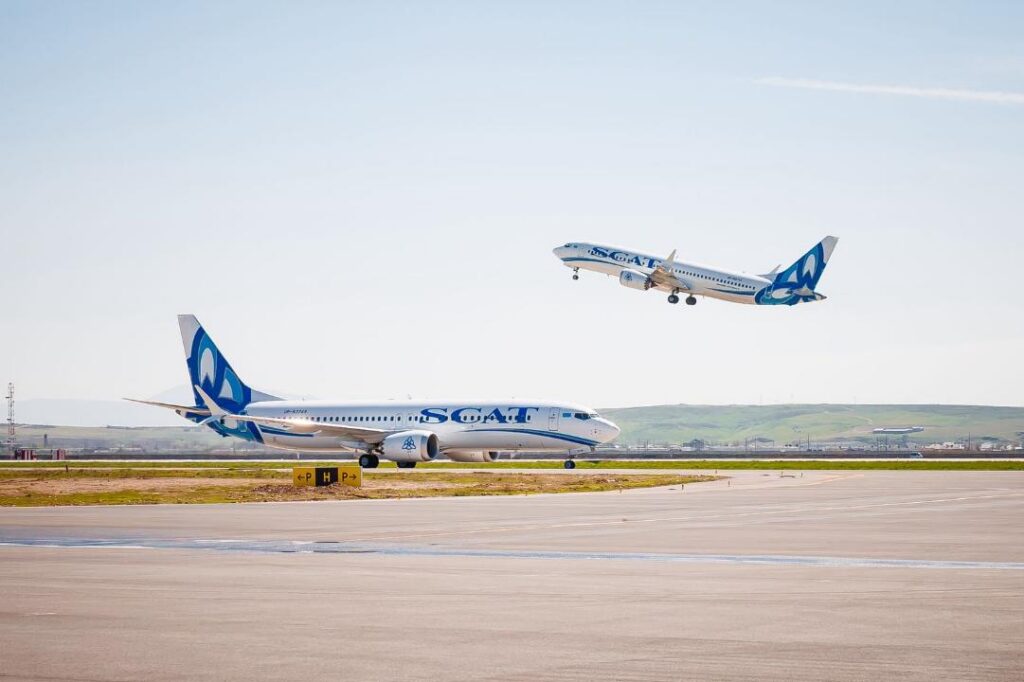

Kazakhstan’s SCAT Airlines Adds Two Boeing 737 MAX 8 Aircraft

Kazakhstan-based SCAT Airlines has taken delivery of two new Boeing 737 MAX 8 aircraft.

The planes were delivered directly from Boeing’s facility in Seattle, marking the first time the carrier has added two aircraft of this type to its fleet simultaneously.

The fleet expansion is linked to the growth of the airline’s route network and the strengthening of existing flight programs. In 2026, SCAT launched new routes from Shymkent to Karaganda, Kostanay, Bishkek, Novosibirsk, St. Petersburg, and Tyumen, as well as a direct service from Astana to Ulaanbaatar.

The new aircraft will support the development of a hub at Shymkent Airport, which is emerging as a key node in the airline’s network.

“It is important for SCAT that the new aircraft will be used to develop the hub in Shymkent and expand the route network,” said company president Vladimir Denisov.

The airline’s fleet currently consists of approximately 40 aircraft. In September 2025, the carrier received another Boeing 737 MAX 8, bringing the total number of aircraft of this type in its fleet to eleven.

SCAT Airlines was founded in 1997. The company’s structure includes Aulie-Ata International Airport in Taraz, a 70% stake in Yuzhnoye Nebo Airlines, and a 40% stake in the Egyptian carrier Red Sea Airlines.

The Times of Central Asia previously reported that SCAT Airlines, in partnership with Boeing, had begun construction of a new maintenance center in Shymkent. The facility will specialize in servicing Boeing aircraft, including the Boeing 737 (Classic, NG, and MAX), Boeing 757 and Boeing 767, as well as the wide-body Boeing 777.

During a working visit to the United States, President Kassym-Jomart Tokayev met with Boeing executives. He noted that airlines including Air Astana, SCAT, and Vietjet Qazaqstan are interested in expanding joint projects that are important for the development of Kazakhstan’s aviation industry.

Bishkek Seeks Stable Grain Supplies from Astana for Flour Millers

The Kyrgyz government is considering new measures to support the flour milling industry, including intensified negotiations with Kazakhstan to ensure stable grain supplies.

Industry representatives, speaking at a meeting with the Ministry of Agriculture, said Kyrgyz flour millers are seeking long-term contracts for the supply of Kazakh grain with fixed volumes and prices. Despite an increase in imports, they noted that enterprises continue to face shortages of raw materials.

According to industry estimates, processing capacity utilization currently stands at around 50%. Millers also pointed to ongoing problems with illegal grain trade at the Kyrgyz-Kazakh border.

The Ministry of Agriculture of Kyrgyzstan said it is conducting negotiations with the Kazakh side, including through diplomatic channels, and expects to secure unimpeded transit of grain and direct deliveries to processing enterprises in the near future.

Authorities also plan to provide preferential financing for the construction of grain storage facilities.

According to the Ministry of Agriculture of Kazakhstan, flour exports to Kyrgyzstan increased 1.8 times over the past seven months, rising from 194,000 to 354,000 tons. Kazakhstan attributes this growth to improved logistics.

At the same time, Kyrgyzstan’s Prime Minister Adylbek Kasymaliev has said that logistical challenges between the two countries remain unresolved.

He stressed the need to accelerate the digitalization of transport and customs procedures to improve transparency and speed up cargo inspections. He also noted that, in some cases, additional control measures are applied at border crossings, including tax assessments and the confiscation of goods.

Pannier and Hillard’s Spotlight on Central Asia: New Episode Coming Sunday

As Managing Editor of The Times of Central Asia, I’m delighted that, in partnership with the Oxus Society for Central Asian Affairs, from October 19, we are the home of the Spotlight on Central Asia podcast. Chaired by seasoned broadcasters Bruce Pannier of RFE/RL’s long-running Majlis podcast and Michael Hillard of The Red Line, each fortnightly instalment will take you on a deep dive into the latest news, developments, security issues, and social trends across an increasingly pivotal region.

This week, the team looks at clashes between Pakistan and Afghanistan and how this affects Central Asian plans for trade routes and export projects.

Special guest on the show this week:

– C. Christine Fair, professor in the Security Studies Program within the Edmund A. Walsh School of Foreign Service at Georgetown University, and an expert in the Pakistani military and Afghan relations.

Iran Conflict Drives Food Price Pressures Across Central Asia

The war around Iran is beginning to push up food price risks in Central Asia as disruptions to shipping through the Strait of Hormuz raise fertilizer and fuel costs, while Tehran’s halt to some food exports adds pressure in regional markets. The impact is not manifesting as shortages, but as rising costs across the systems that produce, move, and sell food.

The United Nations has warned that the crisis is disrupting one of the world’s most important trade corridors for energy and agricultural supplies. A large share of global fertilizer trade passes through the Strait of Hormuz, and reduced shipping traffic is tightening supply and pushing up prices. Higher fuel costs are adding a second layer of pressure on farmers and transport networks.

Fertilizer and fuel are among agriculture’s highest costs. Even modest increases can compress margins quickly, forcing farmers to cut usage or pass costs on, with pressure moving through to retail prices.

Central Asia is particularly exposed to this shift in costs. The region relies on imported fuel and fertilizers, and depends on long, multi-stage transport routes. When costs increase at any point in that chain, they accumulate before goods reach markets.

The second layer of pressure comes from Iran itself. On March 3, Tehran imposed a ban on exports of food products as part of wartime economic measures. Reporting in Tajikistan indicates that the move could affect the availability and pricing of goods such as dairy, sugar, fruit, and spices, particularly in wholesale and lower-cost retail markets.

Iran is not a dominant supplier, but plays a role in specific markets. Tajikistan is the clearest example. Tajikistan has also expanded its economic relationship with Iran in recent years, supported by cooperation in industry and transport. Iranian goods are widely present in retail supply chains, and trade between the two countries has grown steadily in recent years.

That growth is part of a broader trend. Iran’s economic ties with Central Asia have expanded under new trade arrangements and bilateral initiatives. Kazakhstan and Iran have discussed increasing trade turnover to $3 billion, reflecting the rising use of Caspian routes and port infrastructure, which are now under threat.

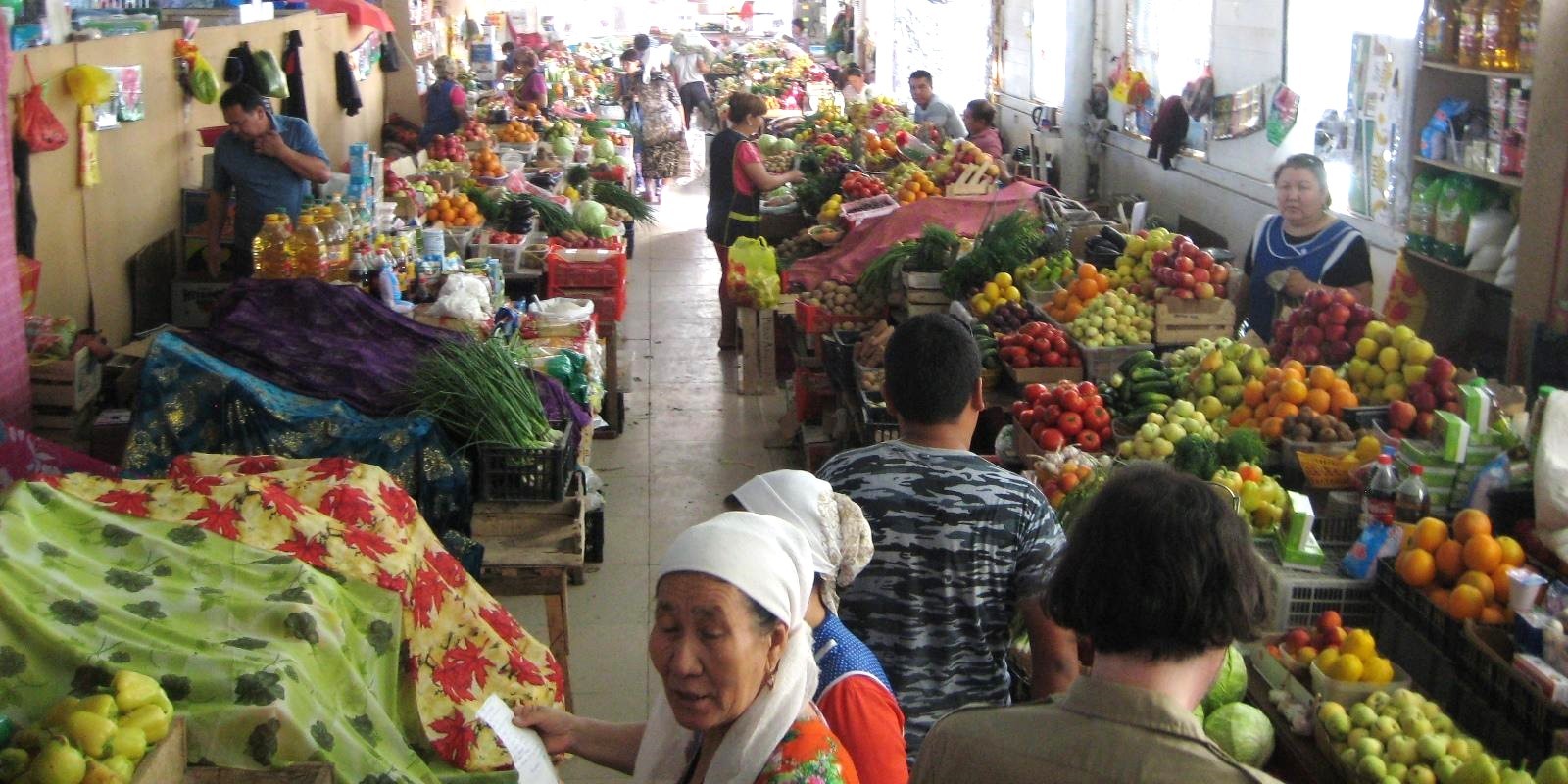
Aralsk Bazaar. Rising transport and fertilizer costs are beginning to push up food prices across the region. Image: Michael J. Bland

Transport adds a third layer of pressure. As risks rise across the Middle East, airlines and freight operators are avoiding large swathes of Iranian airspace and surrounding routes, forcing rerouting and raising costs across supply chains. European aviation safety authorities have issued conflict-zone bulletins warning of heightened risks in the region, and carriers have adjusted accordingly.

Rerouting increases fuel use, extends journey times, and raises insurance costs. Those increases affect cargo as well as passengers, and over time, higher logistics costs feed into the price of imported goods, including food.

On land, the same pattern is visible. As southern routes become less predictable, more freight is shifting toward the Trans-Caspian International Transport Route – the Middle Corridor – which runs through Central Asia, across the Caspian Sea, and through the South Caucasus toward Europe. As more freight is diverted from both Russian and southern routes, the corridor is being pushed to absorb multiple shocks at once, raising the risk of further cost increases as volumes rise.

Kazakhstan reports that volumes along the corridor have risen sharply in recent years, with faster delivery times and growing container traffic. But capacity remains uneven. An assessment by the Organisation for Economic Co-operation and Development identified congestion, port bottlenecks, and delays at key points along the route, including Aktau and Kuryk. An infrastructure notice from the European Bank for Reconstruction and Development, meanwhile, points to the need for expanded handling capacity to manage rising demand at Caspian ports.

These constraints compound across Central Asia’s supply chains, where each transfer between rail, port, and road adds cost and delay. However, the effect is not uniform across the region. As a major grain producer with more developed infrastructure, Kazakhstan harvested more than 27 million tons of grain in 2025, reinforcing its role as a key supplier to regional markets. This provides a buffer against external shocks, but does not insulate it from rising production and transport costs.

Kyrgyzstan and Tajikistan face a wholly different reality. Both depend more heavily on imports and have less fiscal space to manage rising prices. For households already spending a large share of income on food, even gradual price increases can have immediate effects.

In Tajikistan, President Emomali Rahmon acknowledged rising prices directly in his latest public remarks. “According to expert analysis, as a result of recent events in the world, as well as climate change and its adverse effects, food prices will rise at an unprecedented rate this year,” Rahmon said, an unusual admission in a system where such issues are rarely addressed so openly.

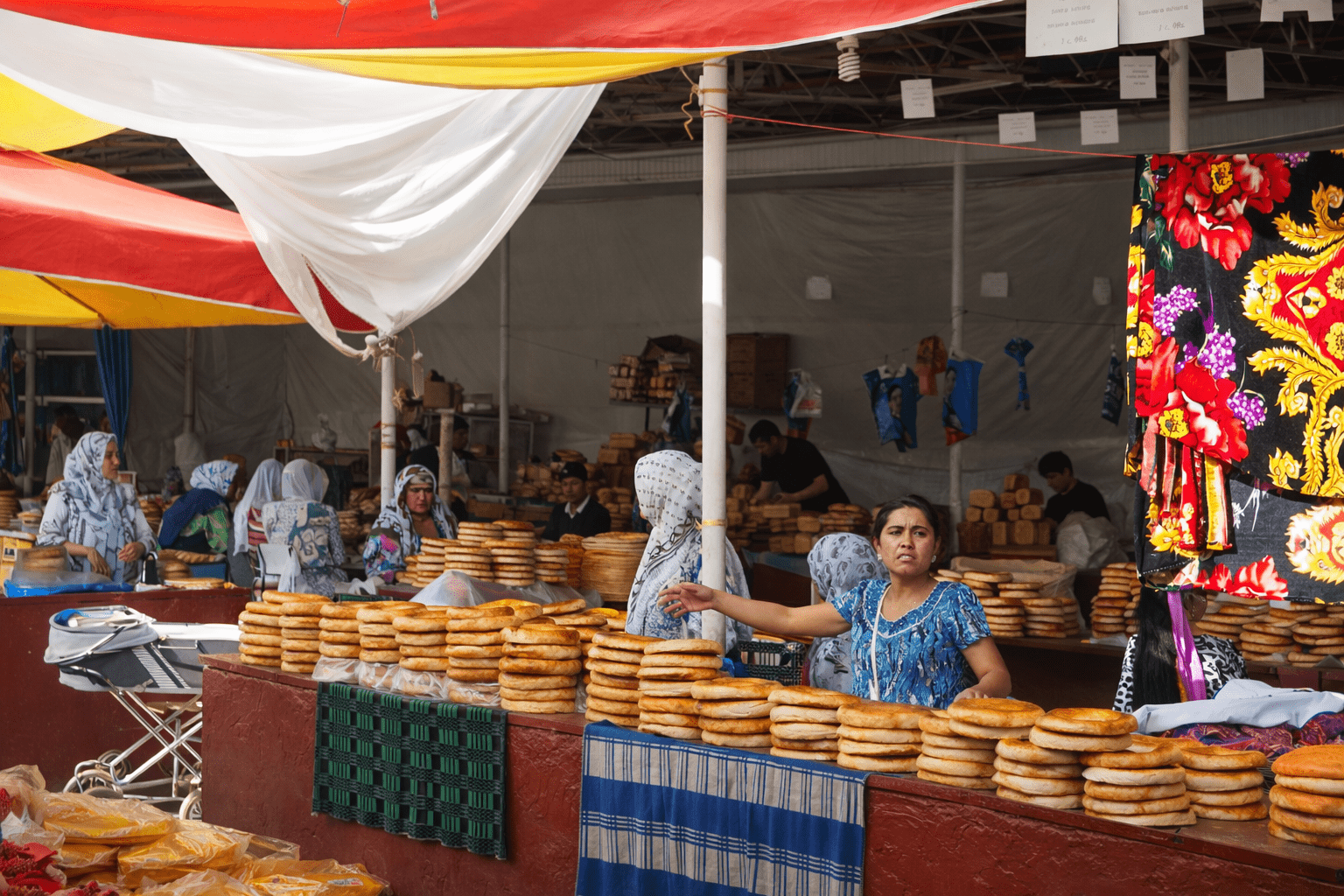
Non bread seller on the Shah Mansur Bazaar, Dushanbe; image: TCA, Stephen M. Bland

So far, there is no clear evidence of widespread food shortages linked to the Iran conflict. Markets remain supplied, and governments have not announced emergency measures in this regard. The impact is gradual and cumulative rather than sudden.

Central Asia has faced similar pressures before. Disruptions to global grain and fertilizer markets in 2022 pushed up prices across the region, leading governments to introduce export controls, subsidies, and other measures to stabilize supply. Those tools remain available but come with fiscal and economic trade-offs. Governments may also turn again to export controls on staple goods, which can stabilize domestic markets but increase volatility across the region.

What is different now is the concentration of risk. Shipping disruptions in the Gulf, higher energy costs, tighter fertilizer markets, and reduced access to Iranian exports are all occurring at the same time. Taken in isolation, each factor alone is manageable, but together they increase the region’s exposure to external shocks.

The war around Iran is not cutting Central Asia off from food. It is making the system that delivers it more expensive, more complex, and more exposed to further shocks.

Khusanov Named Manchester City’s Player of the Month for March

Uzbekistan national team defender Abdukodir Khusanov has been named Manchester City’s Player of the Month for March, the club announced.

In a statement, Manchester City said the 21-year-old “beat the challenges of team-mates Rodri and Jérémy Doku to overwhelmingly win the public vote,” highlighting his strong performances throughout the month. “Khusanov was outstanding during March and has become a firm favourite with the City fans for his committed, all-action defensive style,” the club added.

This marks Khusanov’s third monthly award, after also receiving the honor in January. Last year, he made history by being named the club’s Etihad Player of the Month for February, just six weeks after joining. At the time, the club praised his composure and tactical discipline, particularly his decision-making under pressure across multiple appearances.

Khusanov’s rapid rise has been one of the standout stories in Uzbek football in recent years. Earlier, he was named Asia’s Best Young Footballer of 2025 by Goalpost, reflecting his growing reputation on the international stage.

The defender made history in January as the first player from Uzbekistan to play in the English Premier League. Since then, he has gradually secured more playing time, making several appearances for one of Europe’s top clubs this season.

His performances have also drawn wider recognition. Analysts from The Athletic recently included Khusanov in a list of the world’s most underrated footballers, noting that while his debut against Chelsea was difficult, he has since shown clear improvement and strong defensive qualities.