The development of transport and logistics has become one of the main priorities of Kazakhstan’s economic policy as the country seeks to turn its position between China, Russia, the Caspian Sea, and Europe into long-term growth. Government transport data show the broader transport and warehousing sector grew in January-May 2026, although rail freight and cargo turnover remained under pressure.
Large-scale rail, road, port, warehouse, and digital projects now sit at the center of that effort. The sector requires tens of billions of dollars in investment, while the reshaping of Eurasian supply chains since 2022 has raised the importance of the Middle Corridor and Caspian-linked routes.
Can Kazakhstan attract the capital needed to implement large-scale infrastructure projects? How will changing investment priorities affect regional development? And how could new investment reshape the country’s transport market?
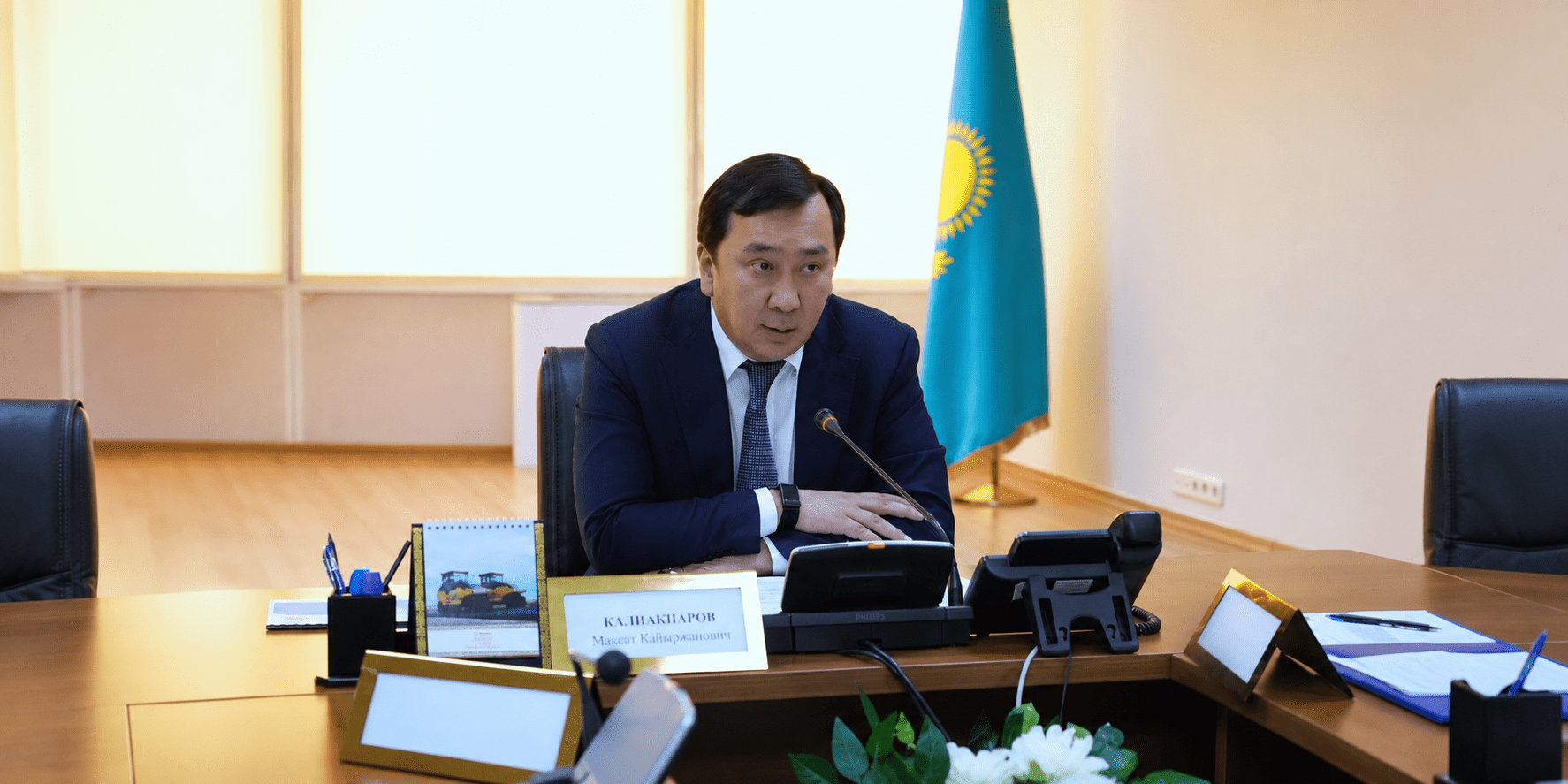
The Times of Central Asia discussed these questions with Maksat Kaliakparov, vice minister of transport of the Republic of Kazakhstan.
TCA: How would you assess the current investment attractiveness of Kazakhstan’s transport sector? How much foreign investment has the industry attracted recently?
Maksat Kaliakparov: The investment attractiveness of the sector is high and continues to strengthen. In 2025 alone, gross foreign direct investment into Kazakhstan’s economy reached $20.5 billion, an increase of 14.4% compared with the previous year. Investment is increasingly flowing into transport and logistics alongside manufacturing, digital infrastructure, and the financial sector.
The transportation and warehousing sector was among the country’s fastest-growing industries in January-May 2026, expanding by 8.4%.
Investor interest is also reflected in the fact that, in 2025, Kazakhstan signed 88 commercial agreements worth more than $69.5 billion with partners from China, the UAE, the United States, and European countries. A significant share of these funds will be directed toward transport and logistics projects.
More broadly, Kazakhstan’s investment policy framework includes a target of increasing annual foreign direct investment inflows to $25.5 billion while raising investment in fixed capital to 25.1% of GDP.
TCA: Which segments of the industry are currently attracting the greatest investor interest: railways, highways, aviation, ports, warehousing, or digital logistics? Which areas will require the largest investments in the coming years?
Maksat Kaliakparov: Investor interest is spread across several major segments.
Railways remain a key priority. Kazakhstan is implementing modernization and new construction projects, including the recently commissioned Dostyk-Moyynty railway section, as well as the Darbaza-Maktaaral and Moyynty-Kyzylzhar lines. By 2030, the country plans to build or modernize approximately 5,000 kilometers of railway infrastructure.
Maritime and port logistics are also attracting substantial investment. Expansion is underway at the ports of Aktau and Kuryk, while a new container hub in Aktau is being built with the participation of China’s Lianyungang Port Group. The project is expected to increase capacity to 240,000 TEU by the end of 2026.
Road infrastructure has secured a landmark private investment through the Car Park Transformer roadside service network.
Warehouse and multimodal logistics continue to develop, including through Kazakhstan’s terminal at Georgia’s Port of Poti.
Digitalization is another important area. In particular, the pilot Smart Cargo platform has been launched, integrating services provided by government agencies and logistics operators.
Looking ahead, we believe the greatest investment needs will be in railway infrastructure, particularly eliminating bottlenecks at border crossings with China, along with construction of the third Kazakhstan-China railway crossing at Bakhty-Chuguchak, expansion of Caspian Sea port capacity, and digital platforms for cargo-flow management.
TCA: What reforms could make transport projects more attractive to investors? What is Kazakhstan doing to improve mechanisms for attracting foreign capital amid intensifying international competition for investment?
Maksat Kaliakparov: The government is implementing a comprehensive package of institutional reforms.
Kazakhstan has adopted an updated Investment Policy Concept through 2030. The Investment Headquarters mechanism is operating with the authority to make binding decisions on issues affecting investment projects. We have also established a National Digital Investment Platform, which creates a unified database of priority investment projects, helping reduce risks while improving implementation monitoring.
As you are probably aware, Kazakhstan now has an investment ombudsman and a Committee for the Protection of Investors’ Rights operating under the Prosecutor General’s Office. In addition, Baiterek Holding is being transformed into a national investment institution.
We are also expanding the network of special economic and industrial zones, while the Astana International Financial Centre continues operating under the principles of English common law.
Within the transport sector specifically, we are reforming both the tariff and institutional models of the railway industry. By the end of 2026, we plan to complete the preparatory stage of the new Railway Transport Development Concept, which includes a new tariff-setting methodology and measures to remove barriers preventing new operators from entering the railway network.
TCA: You mentioned that nearly 90 commercial agreements have been signed with foreign partners. Which countries remain the key investors in Kazakhstan’s transport and logistics sector? What do you see as the main driver behind the growing interest in transport projects in recent years?
Maksat Kaliakparov: Among the countries that consistently account for the largest share of foreign direct investment in Kazakhstan are the Netherlands, the United States, Switzerland, Belgium, Russia, South Korea, China, France, the United Kingdom, and Germany.
When it comes specifically to transport and logistics, China plays a particularly significant role. Since the launch of the Belt and Road Initiative in 2013, Kazakhstan and China have implemented more than 50 joint infrastructure projects, ranging from the expansion of transport hubs to the modernization of railways and ports.
European Union countries are also active investors. The EU accounts for more than 30% of Kazakhstan’s foreign trade, while the United Kingdom is involved in projects such as the Car Park Transformer roadside service network.
The principal driver behind growing investor interest in transport projects has been the development of the Middle Corridor. The geopolitical transformation of global supply chains since 2022 has turned Kazakhstan’s geographic location into a strategic asset, while transit volumes passing through the country have been increasing by an average of 20% annually.
TCA: What barriers continue to discourage private investment in Kazakhstan’s transport and logistics sector? Conversely, which government measures have had the greatest positive impact on improving the investment climate?
Maksat Kaliakparov: According to both industry experts and government agencies, one of the main constraints remains the current tariff model in the railway sector. At present, it does not provide a sufficient balance between investor interests and state regulation, limiting opportunities for infrastructure modernization.
Another challenge has been the historically rigid framework governing concession agreements. Complex procedures and a heavy bureaucratic burden reduced investor interest in concession-based projects, which was one of the reasons Kazakhstan adopted a separate Public-Private Partnership Law in 2015, expanding the range of mechanisms available for private-sector participation.
Among the measures that have already delivered tangible results, I would highlight the simplification of regulatory procedures, stronger investor-rights protection mechanisms, the creation of a unified digital database of priority investment projects, and the systematic work of the Investment Headquarters.
As of early 2026, Kazakhstan had more than 1,100 PPP and concession agreements in force, with a combined value of approximately $5.3 billion to $6.9 billion. This demonstrates growing confidence in these instruments, including within the transport sector, where public-private partnerships remain one of the government’s priority investment mechanisms.
TCA: Which investment models do you consider the most effective: public-private partnerships, concessions, direct investment, or financing from international financial institutions?
Maksat Kaliakparov: There is no universal model. The appropriate mechanism depends on the nature of each project.
For capital-intensive infrastructure with long payback periods, such as highways, railway stations, and roadside service facilities, public-private partnerships and concessions have proven highly effective. These models allow risks to be shared between the government and private investors while reducing the burden on the state budget.
One example is the Car Park Transformer project, which is being implemented through direct private investment under an investment agreement with the government.
For large-scale port and railway infrastructure, foreign direct investment and joint ventures with strategic partners remain particularly effective. For example, the new container hub at the Port of Aktau is being developed in partnership with China’s Lianyungang Port Group.
Meanwhile, loans from international financial institutions, including the Asian Development Bank, the European Bank for Reconstruction and Development, and the Eurasian Development Bank, continue to play an important role in financing major infrastructure programs, including the modernization of Kazakhstan’s railway network.
In our view, the most sustainable results are achieved through a combination of these financing instruments, selected according to the specific requirements of each project.
TCA: Which major transport and logistics projects would you highlight as the most significant in recent years?
Maksat Kaliakparov: Among the most important projects is the commissioning of the second railway track on the Dostyk-Moyynty section, which is expected to increase freight traffic between China and Europe severalfold.
Construction is also continuing on the Darbaza-Maktaaral and Moyynty-Kyzylzhar railway lines.
We are modernizing the Altynkol-Zhetygen and Beyneu-Mangystau sections, while the Bakhty-Ayagoz railway project includes plans to establish a third railway border crossing with China at Bakhty-Chuguchak.
In the maritime sector, construction continues on the container hub at the Port of Aktau. We are also reconstructing port berths, carrying out dredging works, and modernizing Kazakhstan’s commercial fleet.
Another landmark achievement was the opening of the PotiTransTerminal multimodal terminal at Georgia’s Port of Poti, the first privately owned Kazakh terminal on the Black Sea coast.
In the road sector, our priority remains expanding the national highway network. In 2026 alone, Kazakhstan plans to build or rehabilitate approximately 11,000 kilometers of roads, alongside continued implementation of the Car Park Transformer project.
In aviation, I would highlight the expansion of Kazakhstan’s airline fleet to 118 aircraft, as well as the construction of new runways at the airports in Astana and Shymkent.
TCA: What indicators does the Ministry use to evaluate the success of investment projects in the transport and logistics sector?
Maksat Kaliakparov: We use a comprehensive set of performance indicators when evaluating transport and logistics investment projects.
Naturally, one of the key indicators is the volume of investment attracted and whether it corresponds to the targets set out in the investment agreement.
We also assess whether projects are commissioned according to schedule, particularly in cases involving phased implementation.
Another important indicator is the number of jobs created.
We closely monitor increases in cargo-handling capacity and freight volumes, measured in tons for railways and ports, or in TEU for container transportation.
We also evaluate the growth of transit traffic, the project’s commercial performance and investment payback, and, importantly, its contribution to Kazakhstan’s broader strategic development objectives.